




How to Predict & Address At-Risk Driver Behaviors
If not corrected, certain driving behaviors greatly increase the odds the driver will be involved in a crash. Find out how to avoid on-the-job driving accidents.

Any time a driver receives a violation, warning, or citation, address the incident from the behavioral side and work with the driver to eliminate the behavior.
Photo: Work Truck
When it comes to work truck fleet safety, much anecdotal evidence and even a few studies predict future crash involvement by a specific driver. Results from a recent study conducted by the American Transportation Research Institute (ATRI), in conjunction with the North Dakota State Upper Great Plains Transportation Institute (UGPTI), tracked more than 500,000 commercial drivers to determine the probability of being involved in a future accident. The three-year study turned up several surprises relevant to any company whose employees regularly drive on the job.
Understanding Driver Behavior
Drivers in the study were tracked for three years. Any time a participant was involved in a crash, the individual's driving and compliance history was checked. The data was then aggregated.
Surprising study results included:
Being involved in a previous crash is not a reliable predictor of a future crash. In terms of predicting future crash involvement, this factor came in seventh. A crash is many times the result of a bad behavior pattern. If, after a crash, the driver realizes the bad behavior and corrects it, the odds of that driver becoming involved in a future crash are reduced.
Drivers cited, but not convicted, for certain moving violations are more likely to be involved in an accident in the future. Drivers who had received certain violations (not convictions) had an increased likelihood (up to 325 percent) of being involved in a future crash. In contrast, drivers who received a violation for an improper turn were 105 percent more likely to be involved in a future crash.
Among convictions, improper or erratic lane change, failure to yield right of way, improper turn, and failure to maintain a proper lane had the highest increased likelihood of future crash involvement. If a driver was convicted of one of these violations, the likelihood of future crash involvement increased 91-100 percent.
The events showing the highest probability of future crash involvement (followed by increased odds the driver would be involved in a future crash) included:
The study indicates what some safety managers have known for years: If not corrected, certain driver behaviors greatly increase the odds the driver will be involved in a future crash. A driver who "follows too closely" habitually does not maintain adequate space around the vehicle or drives too fast when compared to other traffic. If the driver does not correct the core behavior leading to "following too closely," the driver is at a considerably higher risk of a crash.
Bottom line: "Following too closely" is not the problem; the behavior leading to the "following too closely" is the actual problem.
If It Can Be Predicted, It Can Be Prevented
Now that we understand the behavioral aspect, the next question becomes, "How do I spot a driver with a bad habit?" Several indicators of potentially bad behaviors can be monitored.
A driver receiving a violation, warning, or citation can indicate a problem. The incident involved may have been the driver finally getting caught for an ongoing bad driving behavior or it may have been a one-time incident, but do you want to take the chance?
Any time a driver receives a violation, warning, or citation, address the incident from the behavioral side and work with the driver to eliminate the behavior. If it was a one-time incident, a good driver will become even better, so even in these cases it is still worth the time to work with the driver.
Customer complaints can be another source of predictive data. Most drivers are expected to exhibit certain behaviors around customers. If a driver yells at the customer, is uncooperative, or offends customers with boorish behavior, what are the odds these behavioral traits become driving behaviors? Unchecked, these behaviors lead to a driver at an increased risk of a crash. All drivers get frustrated at customers or have a hard time getting along with a certain customer, but most have the personal self-control (behavioral pattern) to avoid getting into a situation resulting in customer calls and complaints.
Operations complaints fall into the same category as customer complaints. The driver is in a situation in which certain behavior is not acceptable. If the driver has a behavioral pattern that makes it nearly impossible for supervisors to deal with him/her (short-tempered, abusive, aggressive), these same bad behaviors are likely to carry over into driving behaviors.
Driving observations are another tool that can provide insight into a driver's behavior. A word of warning here, however; observations should be vetted to avoid dealing with the wrong driver or helping someone else "grind an axe" with the driver. Once vetted, the complaints can be a helpful tool for spotting drivers with poor driving behaviors, such as taking unnecessary risks, becoming short-tempered or aggressive in traffic or inattentive, or driving generally unsafely (speed and space problems, etc.).
All crashes and near-misses should be reviewed to determine the causes (causal factors and root causes). Once the causes are determined, review potential behaviors that could have led to the crash or near-miss. Finally, counsel and/or retrain the driver based on the results of the review (if you intend to allow the driver to continue to drive company vehicles).
Don't Just Watch It, Fix it
When an incident occurs that indicates bad driving behavior, take action immediately. Action can include everything from a counseling session (pointing out the behavior to the driver) to retraining the driver on defensive driving and road testing. Of course, if the incident is part of a pattern or was serious enough, suspending the driver's ability to drive company vehicles should be considered.
Every incident should be placed into a tracking system. What is worse than a driver with bad behavior? A driver whose bad behavior has been pointed out and refuses to correct it.
People refuse to change behavior for many reasons, even after it has been pointed out as being dangerous. Common reasons include:
Risk homeostasis: "What I do really isn't dangerous."
Arrogance: "I know better than the 'dummies' who write the safety policies."
Voluntary ignorance: "I really don't want to know about this."
Hubris: "I am above all those little issues."
Conflicting motivations: "I know I should drive safely, but I have to get there as fast as possible."
Many times, identifying the reason for a refusal to change can provide the manager the key to motivating the employee to change the behavior.
One final thought: As you build monitoring and corrective mechanisms to track, spot, and correct possible bad behavior, consider implementing programs that identify and reward drivers for good behavior, too. Your tracking should also reveal drivers whose behavior is never an issue. Rewarding behaviors that prevent crashes is just as important as spotting behaviors that lead to crashes.
The concept here is simple: Failure to stop bad behavior perpetuates the bad behavior, but not rewarding good behavior can accidentally stop the good behavior.
More Safety

J. J. Keller Safety Professional of the Year Awards Nominations Now Open
J. J. Keller & Associates is accepting nominations for the 2026 J. J. Keller Safety Professional of the Year (SPOTY) Awards. Winners will receive prize packages valued at up to $47,200.
Read More →
ASE Aligns Automotive Service Professionals Month With Spring and Fall Vehicle Maintenance Campaigns
ASE will move Automotive Service Professionals Month to April and October beginning in 2026-2027, aligning recognition with Car Care Month events.
Read More →
Turning Connected Vehicle Data Into Decisions That Matter
Fleet leaders have more data than ever, but turning that data into clear, actionable decisions remains a challenge. This white paper shows how leading organizations are using connected vehicle data to improve safety, reduce costs, and optimize fleet performance. Learn how to turn insight into action across your fleet.
Read More →

Driver Retention: Motive Automates Driver Coaching & Driver Rewards
New automated rewards and recognition capabilities from Motive can help organizations engage drivers, reinforce positive behavior, and reduce turnover. AI Coach has also been updated to deliver personalized feedback across safety, fuel, and compliance.
Read More →
Experts Forecast Broader Impact of Wildfires in 2026
This year’s wildfire season will likely be more intense than in 2025. The 2026 wildfire forecast from AccuWeather is for fewer fires, but even more acreage will be impacted this year.
Read More →
A Walkthrough of the DataQs Process
Bad data on your carrier record can cost you. Here’s how DataQs helps fleets challenge errors before they hit CSA scores, insurance, and your bottom line.
Read More →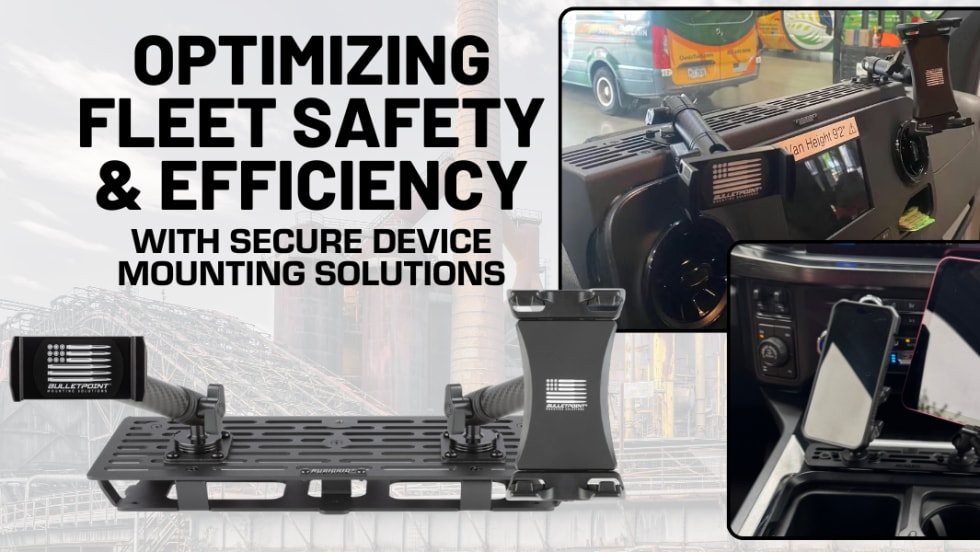
Optimizing Fleet Safety with Secure Device Integration
Unsecured devices are a hidden liability. Learn how precision-engineered mounting solutions enhance driver safety, streamline workflows and protect your technology.
Read More →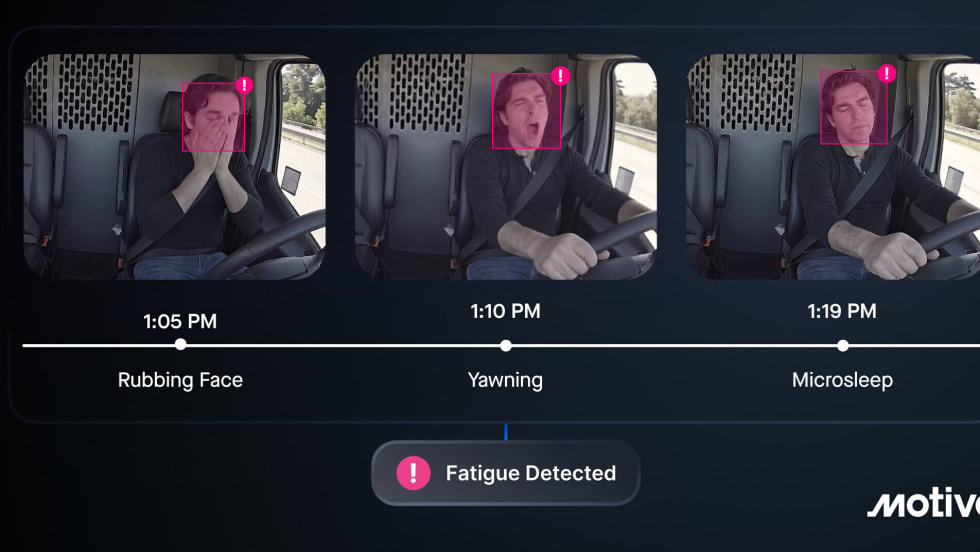
Motive Launches New Edge AI Capabilities to Help Prevent Collisions and Capture Critical Incidents in Real-Time
New AI models from Motive can detect signs of fatigue and eating, plus capture low-severity collisions often missed by telematics.
Read More →
Pro-Vision Acquires Convoy Technologies to Expand Fleet Safety and Video Solutions
Pro-Vision has acquired Convoy Technologies in a deal it said will broaden customer relationships and add specialized vehicle video capabilities for commercial fleets.
Read More →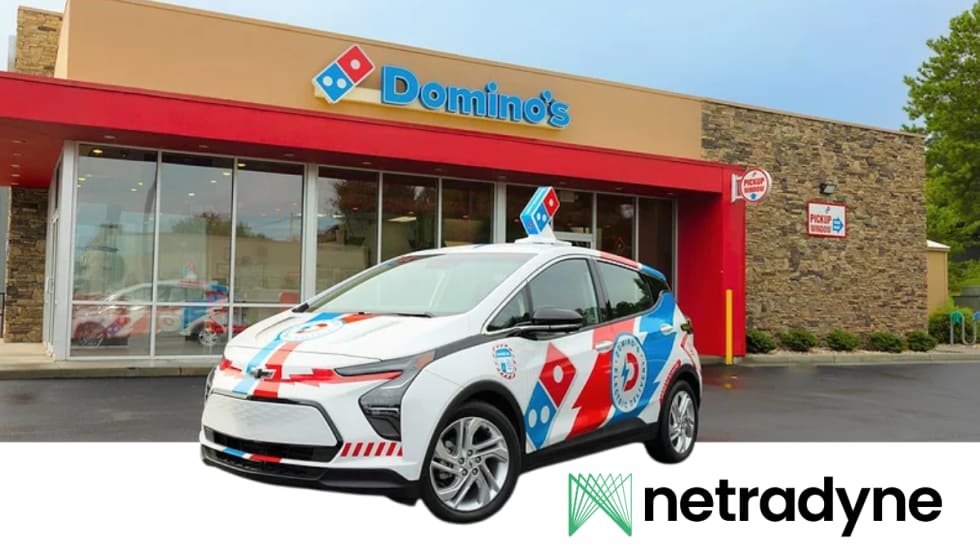
Netradyne Delivers 66% Reduction in At-Fault Crashes Across Domino's Franchise Network
Five Domino's franchises and more than 1,000 vehicles are now running on Netradyne's AI-powered fleet safety and performance platform. Designed for fleets that use personal or non-owned vehicles, FlexMount allows drivers to quickly install and remove Driver-i.
Read More →