




Safety Starts Before an Accident: Understanding StabiliTrak
GM keeps vehicles on the road with all-wheel drive, StabiliTrak, and traction control, and makes sure vehicles stop with anti-lock brake systems.

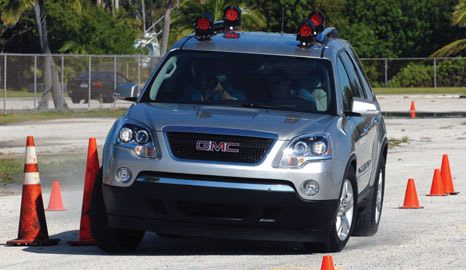
When a vehicle’s wheels lock up on wet and slippery roads or during a panic stop, the driver may lose traction and control, causing the vehicle to spin. Anti-lock brake systems (ABS) keep wheels from locking up, so the vehicle maintains directional control around hazards.
Photo: General Motors
General Motors is focused on providing comprehensive safety before, during, and after a crash. Before, according to the manufacturer, means avoiding a crash. GM has several safety innovations that help keep a vehicle on the road and in one piece.
StabiliTrak Saves Lives
In 1997, GM first introduced StabiliTrak, also known as electronic stability control (ESC), on its vehicles. Using sensors to detect the difference between the steering wheel angle, the direction the vehicle is turning, as well as other situational factors, StabiliTrak applies quick, precise force to the appropriate brakes to help drivers control a vehicle’s direction and keep it on course.
In low-traction conditions such as ice, snow, gravel, wet pavement, and uneven road surfaces, StabiliTrak helps significantly reduce single-vehicle crashes, according to the Insurance Institute for Highway Safety (IIHS). The federal government is mandating ESC on all new light vehicles by 2012. According to the manufacturer, all GM retail cars and trucks sold in the U.S. will have ESC standard by the end of 2010.
Anti-lock Brakes Stop Vehicles Quickly
When a vehicle’s wheels lock up on wet and slippery roads or during a panic stop, the driver may lose traction and control, causing the vehicle to spin. Anti-lock brake systems (ABS) keep wheels from locking up, so the vehicle maintains directional control around hazards.
ABS reduces the chances of wheel lockup by rapidly adjusting brake pressure. More specifically, ABS automatically changes the brake fluid pressure at each wheel to maintain optimum brake performance — just short of locking up the wheels. An electronic control unit regulates brake fluid pressure in response to changing road conditions or impending wheel lockup.
ABS works with the StabiliTrak system and is currently standard on most 2008-model GM vehicles.
Traction Control Keeps Vehicles on the Road
By selectively applying brake pressure to individual wheels, traction control helps reduce wheel spin on loose or slippery surfaces, according to GM. In the past, drivers had to feather the gas pedal to prevent the drive wheels from spinning wildly on slippery pavement.
Traction control systems are designed to help prevent a vehicle from slipping and sliding during acceleration. They improve vehicle stability by controlling the amount the drive wheels can slip when extra power is applied. The system automatically adjusts the engine power output and, in some systems, applies braking force to selected wheels during acceleration. Traction control is found primarily on vehicles with four-wheel, anti-lock brake systems and is standard on most 2008-model GM vehicles.
Additional Safety Features
GM vehicles that come equipped with all-wheel drive (AWD) systems feature the ability to transfer torque to some or all wheels, depending upon conditions. According to GM, this allows the system to maximize fuel economy, traction, or both.
Additional safety features such as daytime running lamps have saved 433 lives and averted 85,000 crashes of all types since 1995, according to the manufacturer.
Another new innovation is Eye Cue. By projecting critical information such as speed, high-beam status, turn signal status, and “check gauges,” onto the windshield, Eye Cue helps keep eyes where they belong: on the road ahead.
Originally posted on Automotive Fleet
More Small Fleet
Why Fleet Managers Are Replacing Departmental Vehicles with Shared Motor Pools
Departmentally assigned vehicles often create hidden costs through underutilization, poor visibility, and increased administrative burden. This white paper explores how shared motor pool strategies help fleets reduce costs, improve accountability, and optimize vehicle utilization.
Read More →
Boosting Last-Mile Fleet Uptime, Safety, and Value with AI Vehicle Inspections
AI-powered inspections are transforming last-mile fleets by replacing manual checks with highly accurate automated scans that detect defects in seconds. By giving fleet operations visibility into the daily condition of their vehicles, you can identify trends over the vehicle’s lifecycle that enable improved procurement decisions, route management, driver training and accountability.
Read More →
Five Ways Seat Belts Help Prevent Injuries
There are five ways seat belts protect occupants from injuries, according to the Tennessee Department of Safety and Homeland Security.
Read More →
It’s here: The 2026 Fleet Technology Trends Report
What does AI mean for fleets? Get the answer — and learn other top tech trends.
Read More →
Small Fleets, Big Impact: How Independent Drivers Power Wreaths Across America
Check out how small fleets and independent drivers power Wreaths Across America each December and why their impact matters more than ever.
Read More →
VMS Survey Finds 65% of Small Fleet Managers Run Operations Alone
A new VMS survey shows small fleet managers are stretched thin, with most handling operations solo and eager to adopt digital tools for relief.
Read More →
Tips for Driving Safely on Halloween Night
This video features a reminder from the Connecticut Department of Transportation (DOT) and the Connecticut Police Chiefs Association, urging drivers to prioritize safety this Halloween.
Read More →
AI, Access, and Uptime: VMS’s Next Chapter with David Prusinski
VMS’s new Co-CEO, David Prusinski, shares how an AI-first approach will give small fleets and repair shops the tools to compete like big players.
Read More →
Fleet Managers Share Winter Prep Tips: It's Never Too Early!
Three fleets share best practices to prep vehicles for winter and prevent downtime when the cold sets in.
Read More →
Hot Weather Driving Tips for Fleet Drivers
As we head into another potentially extreme summer season, the risks for fleet drivers remain high, from engine strain and tire blowouts to unpredictable traffic patterns. An expert shares advice on how fleet drivers can boost their safety during the steamy summer months.
Read More →