




How to Determine the Correct Depreciation Reserve
Depreciation turns fleet vehicles into “melting” assets. The open-end TRAC lease is an excellent tool to manage depreciation expense; however, maximizing its effectiveness requires establishing the proper depreciation reserve.
It is one of the most creative and unique financial instruments for managing a vehicle fleet. The open-end terminal rental adjustment clause (TRAC) lease has been a staple in the fleet industry for decades. However, sometimes the basic principles of the TRAC lease are misunderstood.
A basic tenet of accounting is to match expense with the period in which it occurs. Open-end TRAC leases enable fleet managers to do so, but only if the various terms used in the lease are understood and applied correctly.
The first step in creating a proper depreciation reserve is to know and understand the various components of the open-end TRAC lease. These components are often (wrongly) used interchangeably.
First, what is a TRAC? It is merely a clause stating that, at the point when the lessee has decided to terminate the lease of a particular vehicle, the following occurs:
The lessor causes the vehicle to be sold.
If the proceeds exceed a predetermined value, the excess is returned to the lessee.
If the proceeds fall short of that predetermined value, the lessee makes up the difference to the lessor.
Thus, the “terminal rental adjustment” is one of three things: nothing (where the proceeds are exactly the same as the value), an additional lease payment by the lessee (where the proceeds are less than the value), or a credit back to the lessee (where the proceeds exceed the predetermined value).
Several primary terms are used in any discussion of the depreciation component of a TRAC lease.
- Amortization:
This is the rate at which the principal of a loan is reduced to zero over the loan period. In the case of a TRAC lease, vehicle cap costs are amortized over some period of months, in equal increments, toward the goal of matching the unamortized amount at replacement with the vehicle’s market value.
- Depreciation:
Depreciation is simply the difference between the original cost of a fixed asset and the proceeds from the sale of the asset. Depreciation, therefore, cannot be determined until after the asset is sold. Often called “actual depreciation.”
- Depreciation Reserve
: In a TRAC lease, each month’s payment contains a repayment of principal — a portion of the original cost — similar to the repayment of a loan. These payments accumulate into a reserve for the anticipated depreciation of the vehicle when it is finally sold.
- “Book Value”:
A vehicle’s socalled book value in a TRAC lease is simply that portion of the cap cost that remains after amortization payments have been paid. Also called the “unamortized” book value. Resale proceeds are applied against this value, to determine the terminal rental payment under the TRAC.
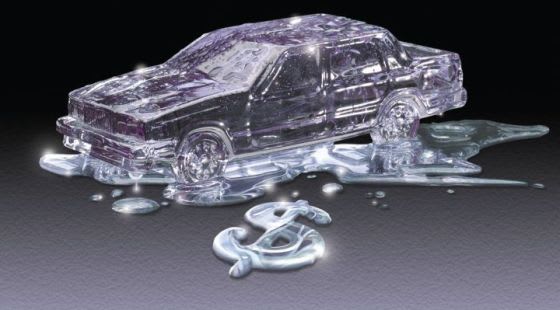
In a majority of fleet leases, “predetermined value” is agreed upon at inception, when the lessee and lessor agree upon the rate at which the original cost (“capitalized cost”) of the vehicle is reduced, or amortized. In theory, this is the rate at which the actual (market) value will decline over time, so that at the point when the vehicle is sold, the remaining value matches the vehicle’s actual value on the open market. In effect, a portion of each lease payment is set aside — “reserved” — to cover the depreciation that inevitably occurs as the vehicle ages and mileage accumulates. Example A illustrates how a TRAC lease works.
Example A
Assume that the cap cost of the vehicle is $20,000. The lessee (fleet) has a replacement policy that states vehicles are replaced at 36 months or 70,000 miles, whichever occurs first. The vehicle in question will drive 2,400 miles per month; thus, under the policy, it is anticipated that it will be replaced after 29 months in service (having reached the 70,000 mile criterion before the 36-month limit). Further, the fleet anticipates that at that point, the vehicle will have a market value of $8,400. Ideally, then, the lease (predetermined) value, against which the actual sale proceeds will be applied, should be $8,400, after 29 lease payments are made. The open-end TRAC lease accomplishes this by amortizing the original cap cost at a rate such that at replacement, the unamortized (book) value reflects the market value:
Cap Cost: $20,000
Amortization rate: 50 months (2 percent per month)
Replacement: 29 months
Monthly amortization: $400 ($20,000/50=$400)
Depreciation reserve: $11,600 ($20,000/(29X$400)=$11,600)
Unamortized (book) value: $8,400 ($20,000 - $11,600 = $8,400)
If the fleet planning in example A is correct, the vehicle will be sold, and the proceeds, $8,400, will be the same as the unamortized value, and the TRAC will result in no further exchange of funds between lessee and lessor. The purpose, therefore, of the TRAC lease is to provide fleets with a mechanism by which they may have the flexibility of ownership in a lease transaction, flexibility that includes residual risk. Returning, once again, to the accounting principle that expense should be recognized in the period in which it occurs, the goal of reserving for anticipated depreciation is to match, as accurately as possible, the amortization of the original cost with the actual depreciation the vehicle incurs.
That “matching” goal sometimes becomes obscured in routine, as fleets and lessors lock themselves into one rate of amortization for the entire fleet. Any fleet widely dispersed geographically will necessarily see similarly dispersed vehicle usage: high-mileage vehicles in sparsely populated areas, lower-mileage vehicles in urban areas or in difficult weather and topographical conditions. A time/mileage replacement policy results in vehicles replaced at varying times, and varying market values. The use of a single amortization rate to reserve for depreciation cannot meet the accounting goal of expense/period matching.
[PAGEBREAK]
Understanding a TRAC lease’s various components and how they interact, we can now begin to analyze how they can be used to develop a depreciation reserve rate that best meets a fleet’s unique needs.
Before this analysis can be done, however, the fleet manager must access historical data, to see how actual resale performance is impacted by the replacement policy and what the experience has been in TRAC adjustments. Some assumptions help develop the model:
Fleet of 500 vehicles.
Replacement cycle of 36 months/70,000 miles, whichever occurs first.
Fleet is national in scope; different territories experience different usage (mileage, etc.).
Amortization rate (rate of reserve) is 50 months. (2-percent per month) for the entire fleet.
Over the prior three years, the fleet has been entirely replaced.
It is not possible for any fleet to replace vehicles in exact accordance with its policy; some vehicles are replaced sooner, some later. This is primarily due to seasonal issues, driver turnover, and inventory requirements. In this test case, about 167 vehicles are replaced each year.
The first step in the analysis is to break the company territories down into groups that reflect differing usage, mileage driven, topography, etc.
Urban.
Suburban.
Rural.
Extreme (mountainous terrain, desert, off-road).
The lowest mileage accumulation would be in the urban and, to a lesser extent, suburban territories, and the highest mileage in the rural areas. Extreme usage will have both; however, this usage places extreme demands on the vehicles.
The next step is to review the historical data on vehicles sold with an eye on that period in the replacement cycle when the sales took place and to which territory group the vehicle can be assigned. The TRAC payment for these sales generally shows whether the reserve rate properly reflects the usage:
- Category 1.
250 vehicles sold (in the prior three-year period) between 24 and 27 months and between 68,000 and 72,000 miles. Average TRAC adjustment is +$425.
- Category 2.
200 vehicles sold between 18 and 24 months with 68,000-72,000 miles. Average TRAC adjustment is for these is -$2,200.
- Category 3.
50 vehicles sold at 36 months or more with greater than 80,000 miles. The average TRAC adjustment is +$1,400.
At first glance, it seems that overall the 50-month reserve rate is working fairly well for those vehicles replaced at or near the policy. However, the earlier they are replaced (accumulating mileage more quickly), the reserve rate accuracy begins to deteriorate; the market value declines at a faster rate than a 50-month reserve can reflect. Finally, those 50 vehicles kept beyond the policy, without exceeding the replacement mileage by a great deal, saw that reserve rate significantly faster than the market rate.
What does this exercise show? First, for at least half the fleet, the reserve rate fairly reflects the market. For vehicles sold in two years or thereabouts with close to the targeted mileage, a reserve rate of 50 months does a solid job reflecting how these vehicles depreciate.
For category two, which shows vehicles that accumulate mileage more quickly, however, this doesn’t appear the case. How so? The TRAC adjustment using 50 months as a reserve rate is substantially greater (a payment of $2,200 to the lessor versus a credit of $425 to the lessee, a difference of $2,625), which reflects the fact that a newer, higher-mileage vehicle declines in value at a rate faster than 50 months. Finally, the 50 vehicles in category three, which build mileage at a rate slower than the previous two (perhaps urban territories) reflect the greater value of slightly older vehicles with lower mileage.
Based upon this data, the fleet manager can reasonably assume that, although there is a small TRAC adjustment, it is not substantial enough to use a different reserve rate. Further research would reveal which territory category these vehicles inhabit, interesting data to the extent that if one category dominates, reserve can be established by category, rather than on a case-by-case basis.
It is also likely that those vehicles that fall into the third TRAC category (longer-term, lower-mileage) might well fall into the urban territory designation, where mileage is accumulated more slowly.
[PAGEBREAK]
What then might a fleet manager do when faced with resale data as
outlined? This example is a calculation for a vehicle in the second category of resale:
Cap Cost: $20,000
Reserve rate: 2 percent (50 months, or $400/month)
Time in service: 20 months
Total reserve: $8,000 (20 X $400 = $8,000)
Unamortized value at resale: $12,000 ($20,000 - $8,000 = $12,000)
Resale proceeds: $9,800
TRAC adjustment: $2,200 to the lessor ($12,000 - $9,800 = $2,200)
The original value of the vehicle is clearly not being amortized at a rate that properly reflects the vehicle’s actual market depreciation rate. If the fleet manager adjusts the reserve rate to, say 40 months, the calculation is the following:
New reserve rate: $500/month ($20,000/40 months = $500)
New total reserve: $10,000 ($500 X 20 months = $10,000)
New TRAC adjustment: $200 credit to the lessee ($10,000 - $9,800 = $200)
By making this adjustment, the fleet manager has considered the faster rate of actual depreciation on these vehicles and increased the rate at which the reserve is accumulated. The result is an unamortized value that more accurately reflects the vehicle’s actual market value at termination. This will avoid the large cash flow outward at lease end, facilitate budgeting, and better match the realization of the expense to the time in which it occurs (making the company’s auditors more comfortable with the transaction).
It is, of course, impossible to tune the reserve rate so finely as to approach an average zero TRAC adjustment. Nor is it necessary. The vagaries of the used-vehicle marketplace make this accurate of an adjustment nearly impossible. A brief discussion with the company’s auditors or the accounting department will familiarize the fleet manager with an acceptable level of TRAC adjustment. Achieving an adjustment within $500 each way, for example, seems more acceptable than adjustments of thousands of dollars and more reflective of the actual timing of the expense.
There is, of course, a downside, and it is based in the time value of money. In the example provided, those vehicles for which the reserve rate amortizes the value too slowly (to match the market) would suffer a $100/month “hit” in cash flow, as the remedy increasing the rate increases the monthly depreciation reserve (and thus the lease payment) by that amount. Further, the TRAC adjustment is made 20 months after the inception of the lease, in dollars less valuable than they would be at inception.
The effect would be limited, however, as the additional reserve would similarly be discounted over time. At any rate, the purpose of the TRAC isn’t to maximize cash flow or delay the booking of expense. It is to allow the fleet to recognize the expense as it occurs, while retaining the flexibility to do so for vehicles of widely varying usage.
In the sample fleet described, vehicle usage differs, resulting in a number of different results when the TRAC adjustment is made. Justifying a single reserve rate for the entire fleet therefore becomes difficult.
Most of the issue lies in mileage. The faster mileage accumulates, the more quickly a vehicle is replaced under the time/mileage policy and its value declines in the open market. It then becomes incumbent upon the fleet manager, after reviewing the data, to adjust the reserve rates for different classes of vehicles.
In the example provided, the 50 month/2-percent per month rate is acceptable for more than half the fleet (250 units sold). For the 200 whose mileage accumulates more quickly, a reserve rate of 40 months (2.5-percent per month) reduces the original value more accurately, and the existing TRAC adjustment average of $2,200 is reduced to $200.
The third class of vehicle, those whose mileage accumulates more slowly, and whose time in service is lengthened, can be viewed as exceptions, and treated on a case-by-case basis. If the exceptions are consistent, the reserve can be adjusted so that less is reserved each month, and the unamortized value is higher at replacement.
Originally posted on Automotive Fleet
More Operations

What Does a Potato Have to Do with Leadership?
From simple process improvements and creative problem-solving to the little moments that strengthen team culture, this conversation dives into the power of unexpected ideas and why innovation doesn't always arrive wrapped in new technology or a major initiative.
Read More →
Looking for a New Podcast for the Road? Start Here!
Looking for a new podcast? Truck Chat delivers fleet leadership insights, industry deep dives, AI discussions, innovations, and real-world stories.
Read More →
Did You Know What You Don't See May Be Costing You Big?
As more employees choose personal vehicles (including hybrids and EVs) for business use, companies face new challenges around visibility, insurance, liability, and cost control.
Read More →

Veteran Voices in Fleet | How Military Service Shapes Fleet Leaders
Across every perspective, one message is clear: the experiences gained through military service continue to influence how veterans contribute to the fleet industry every day.
Read More →
The Fleet Lessons That Don’t Show Up on a Spreadsheet
From index cards to predictive maintenance, Robert Martinez shares the hard-earned leadership lessons that shaped nearly 40 years in fleet.
Read More →
People, Leadership & the Skilled Trades Opportunity | Weekly Cheat Sheet
People, data, leadership, and the skilled trades opportunity. See what's shaping fleets today in this week's Truck Chat Weekly Cheat Sheet.
Read More →
Everyone Thinks They’re a Fleet Manager
From oil changes to procurement decisions, fleet work is often underestimated by the very people who depend on it most. Bob Stanton makes the case for why communication, not just technical expertise, is one of the most important leadership skills in fleet.
Read More →
Turning Connected Vehicle Data Into Decisions That Matter
Fleet leaders have more data than ever, but turning that data into clear, actionable decisions remains a challenge. This white paper shows how leading organizations are using connected vehicle data to improve safety, reduce costs, and optimize fleet performance. Learn how to turn insight into action across your fleet.
Read More →
From Military Service to Fleet Leadership | Shades of Fleet
Military service ends, but the lessons don't. Hear how veterans are shaping fleet leadership through adaptability, teamwork, and mission-driven thinking.
Read More →
Are You Tracking Your Fleet's True Total Cost of Ownership?
Bobit Business Media surveyed 190 fleet professionals and found that while most fleets are tracking costs, fragmented systems and data gaps are keeping true TCO visibility out of reach. With rising pressure to control spend in an increasingly volatile environment, the gap between what fleets think they know and what the data actually shows is wider than you might expect. See how your peers are managing costs today and where the industry still has room to improve.
Read More →