




Dig Deeper: Gearing Up for Upcoming Medium- & Heavy-Duty Truck Regulations
Malfunction Indicator Mandated for 2010 Emissions Standards
Starting in 2010, OEMs will be required to install dashboard malfunction indicator lights and diagnostic trouble codes on heavy-duty trucks to warn drivers of emission problems.

Grace Lauron・Former Associate Editor
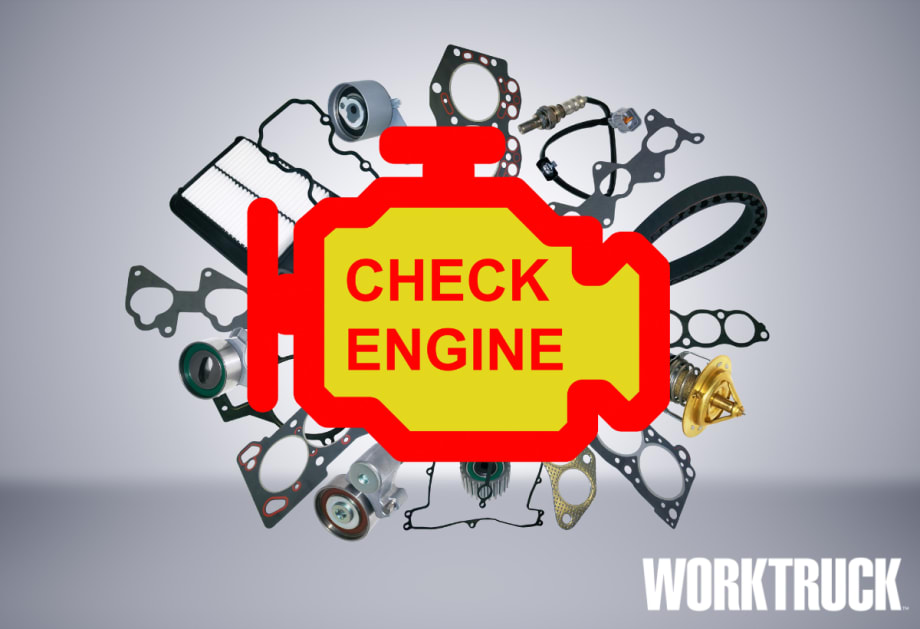
The EPA requirement will provide truckers dashboard malfunction indicator lights and diagnostic trouble codes similar to those on passenger vehicles since the mid-'90s.
Photo: Work Truck
2 min to read
The prevention of 8,300 premature deaths, more than 9,500 hospitalizations, and 1.5 million lost work days are just a few of the substantial benefits the Environmental Protection Agency (EPA) hopes to realize by reducing annual vehicle emissions with its recent onboard diagnostics (OBD) requirement. Formally approved on Dec. 4, the ruling seeks to reduce overall diesel emissions by more than 90 percent through a 2010 mandate requiring heavy-duty truck manufacturers to install OBD technology.
Designed to monitor the performance of an engine's major components, the built-in, computer-based systems will provide a simple, quick, and effective way to alert drivers when engine emission systems are malfunctioning or deteriorating, according to the EPA.
The Air Resources Board (ARB) reported that 33 states and local areas have already begun incorporating onboard diagnostics to comply with the Clean Air Act's goal of reducing air pollutant emissions, a number surely to expand over the next year with the EPA's new rule.
Cleaning is 'Greening'
In September, with OBD considered a critical element in an overall emissions control program, the EPA worked with the State of California to finalize a consistent set of heavy-duty onboard diagnostic (HDOBD) requirements. As a result, the EPA's HDOBD program largely resembles the California program in almost all important aspects.
The EPA requirement will provide truckers with dashboard malfunction indicator lights and diagnostic trouble codes similar to those on passenger vehicles since the mid-'90s. A provision in the rule also requires manufacturers to make available to mechanics information necessary to perform repairs and maintenance services on OBD systems and related components.
The highly technical and detailed 475-page rule applies to 2010 and later model-year engines and will be phased in gradually. Beginning in 2010, engine manufacturers will be required to produce one engine line for heavy-duty trucks that complies with the new rule. By 2013, the dashboard lights will be mandatory for all highway engines.
Without the warning device, a driver could easily overlook emission problems, the EPA regulation stated.
Despite concerns from groups such as the Engine Manufacturers Association that meeting the OBD requirements would present challenges, the EPA said sensors needed to comply with the requirements already are available and will exist in time for 2013 compliance. In addition, the EPA said it will "keep abreast of technological advances in the coming years" in the event the requirements must be modified.
Subscribe to Our Newsletter
More Green Fleet

Landi Technologies Achieves CARB Certification of Ford 7.3L RNG/CNG Platform
Landi Technologies has gained CARB certification of its Ford 7.3L Renewable Natural Gas (RNG) and Compressed Natural Gas (CNG) platform for the Ford E-450, F-450/550/600, F-650/750, and F-53/59 platforms.
Read More →
Sponsored•June 1, 2026
Turning Connected Vehicle Data Into Decisions That Matter
Fleet leaders have more data than ever, but turning that data into clear, actionable decisions remains a challenge. This white paper shows how leading organizations are using connected vehicle data to improve safety, reduce costs, and optimize fleet performance. Learn how to turn insight into action across your fleet.
Read More →
Sponsored•May 29, 2026
Are You Tracking Your Fleet's True Total Cost of Ownership?
Bobit Business Media surveyed 190 fleet professionals and found that while most fleets are tracking costs, fragmented systems and data gaps are keeping true TCO visibility out of reach. With rising pressure to control spend in an increasingly volatile environment, the gap between what fleets think they know and what the data actually shows is wider than you might expect. See how your peers are managing costs today and where the industry still has room to improve.
Read More →
Epic Charging Acquires Bluedot Technologies
Epic Charging has acquired Bluedot Technologies, expanding EV fleet charging access to more than 80% of U.S. public charging networks.
Read More →
CALSTART Adds 64 New Sites and Features to Its Medium- and Heavy-Duty Zero-Emission Infrastructure Map
CALSTART’s interactive National Medium- and Heavy-Duty Zero-Emission Infrastructure Map now locates approximately 1,500 ports at 162 total public, semi-public, and shared electric vehicle (EV) charging and hydrogen refueling facilities for Class 2b-8 trucks.
Read More →
Mack Trucks Expands Full-Service EV Infrastructure Providers
Mack Trucks has expanded its comprehensive Turnkey Solutions program for Mack battery-electric vehicle customers with the addition of two new full-service providers, ABM and Lane Valente Industries.
Read More →
EV Realty Opens Major Truck Charging Hub in California’s Inland Empire
EV Realty’s San Bernardino Powered Properties’ truck charging hub, which has now opened, can serve over 200 medium- and heavy-duty trucks per day.
Read More →
WEX Launches Solution to Close the EV At-Home Charging Visibility Gap for Fleets
WEX unveiled its EV At-Home with Vehicle Fraud Protection, which ensures accurate and secure reimbursement for at-home charging.
Read More →
Toyota Motor Corporation to Join Daimler Truck & Volvo Group in Fuel Cell Joint Venture Cellcentric
Toyota intends to join Daimler Truck and Volvo Group as an equal shareholder in Cellcentric. All three shareholders intend to further strengthen Cellcentric as a leading manufacturer of fuel cell systems for heavy-duty commercial applications.
Read More →
Volvo Penta Electric Drivetrain Powering Terminal Tractors
Volvo Penta and Volvo Financial Services (VFS) have partnered to support one of Northern Europe's largest shipping and logistics companies in its ambition to transition to electric terminal tractors.
Read More →