





Keep Reading: Driving Higher Returns with Smart Work Truck Remarketing
Forecast of Medium-Duty Resale Values for 2011-2012
There is a shortage of medium-duty trucks in the wholesale market due to the low volume of new units ordered from 2007 to 2010. This inventory shortage is forecast to persist for several years. The net result is higher resale values.
September 6, 2011
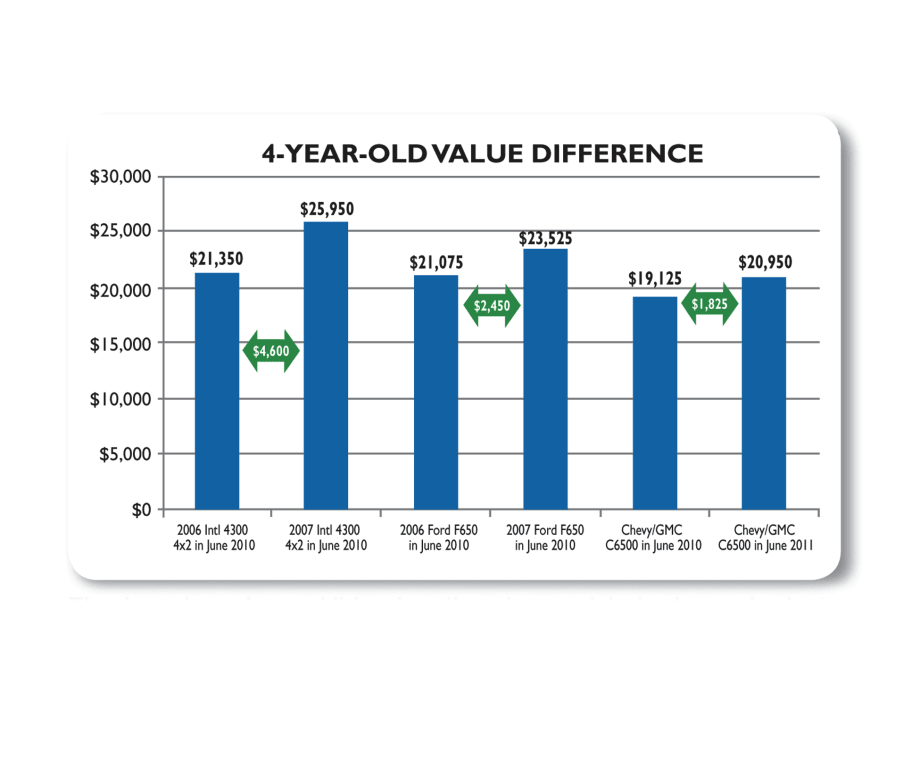
The chart above shows additional medium-duty models that have gained value during the past year. This chart shows that the medium-duty truck buyers now realize that clean, used medium-duty trucks are worth more by avoiding new truck prices.
Sourc: GE Capital Fleet Services
14 min to read
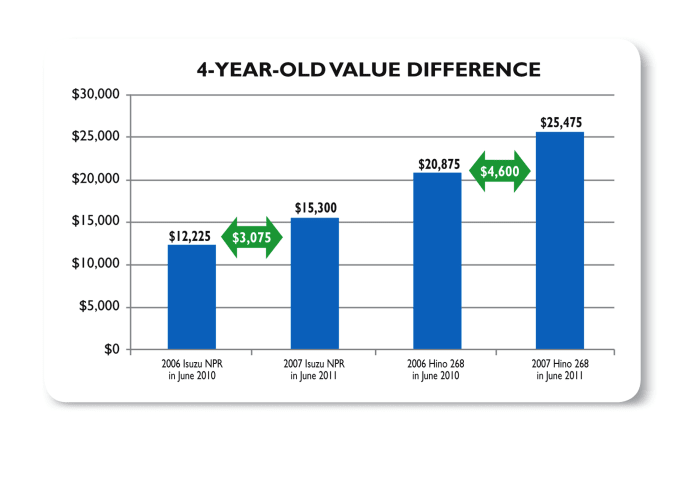
Cab forward and import commercial medium-duty truck models show strength as four-year-old models increased year-over-year. Cab forward and import commercial medium-duty truck models show strength as four-year-old models increased year over year. There is a good bit of jockeying around among this group and some of the players are concentrating more on their main target markets and not trying to be everything to everybody.
Sourc: GE Capital Fleet Services
The decline in new medium-duty truck sales from 2007-2010 has created a tight supply of used trucks in today's wholesale market. As a result, demand is exceeding supply, especially for lower-mileage, well-maintained medium-duty trucks, exerting upward pressure on resale prices across the board.
Increased economic activity nationwide is bolstering demand for medium-duty trucks in both the new- and used-truck markets. The increased demand for new medium-duty products has lengthened order-to-delivery (OTD) times. Not only have build times increased, but so have upfit OTD times.
"Today's wholesale medium-duty truck market is strong and much improved over last year. As the economy and consumer confidence improve, the ripple effect will increase the demand for medium-duty trucks," said Paul Seger, vice president of asset remarketing for GE Capital Fleet Services.
Concurring with this assessment is John Storz, the resale manager for medium- and heavy-duty trucks and equipment at Automotive Resources International (ARI). "The market is very strong. Of the clean units I have sold this year, prices are up 25%," he said.
Not only is inventory tight in the wholesale market, it is also tight in the new-vehicle market.
"The market for new medium-duty is very tight," said Mike Butsch, director of global fleet operations for Joy Global in Milwaukee. "Upfit times at quality upfitters are 12 to 16 weeks compared to four to six weeks last year."
This assessment is reinforced by observations from the resale guidebooks.
"The used wholesale market for medium-duty trucks is very good right now. Similar to the auto market, a tight, limited supply is the primary driver, along with the availability and cost of new models. Although new-model orders are up a reported 30 percent over this time last year, some companies are still trying to fill their needs with used units. Once these currently ordered new models hit the ground, the supply of used trucks will increase slightly, possibly easing up the value levels," said Ricky Beggs, vice president and managing editor of Black Book. "Increased inventory when new orders are delivered will show how strong the market really is and the demand within the market for quality used units. Another scenario affecting supply is the fact that the number of repossession units being remarketed is also at lower levels than in past years."
As several industry observers caution, it is necessary to keep in mind that the sales gains of the current new-truck market are relative to one of the worst economic downturns in the nation's history, from which we are slowly emerging. The business activity may be improving, but it still remains sluggish and even lackluster in certain industry segments. For instance, the three key business segments that drive medium-duty truck purchases are vocational applications, construction, and government. Today, all three segments are struggling in a lackluster economy. Among the 11 major truck OEMs manufacturing Class 4-7 trucks, total sales for FY2010 were 56,643 units. This compares to 154,690 units sold by the same 11 OEMs in FY2006. Sales for Class 4-7 trucks haven't been this low since the 1991-1992 recession.
"While we have experienced some improvement in the secondary markets for Class 6 and 7 trucks since hitting their nadir in 2009, both in terms of return and time to sell, we have certainly not returned to the market conditions that largely prevailed in 2007/early 2008," said Steve LaPorte, director, business operations, North American Transportation & Shred Operations for Iron Mountain Information Management, Inc., in Boston. "It is hard to say when we actually saw rock bottom and when the market bounced back, mostly because I just about stopped selling for approximately 18 months. I would say fall 2010 was when we started to notice the bounce back."
In addition, external factors, such as fuel price volatility, have a direct impact on new truck acquisitions and resale values. "It will be interesting to see if the recent downturn in fuel will have any bearing on used-truck sales," said J.J. Keig, CAFM, fleet manager for NCH EcoServices.
Trending Upward After Hitting Bottom
The decline in medium-duty resale values began in late 2007, when the residential construction slowdown began. In 2007, resale values declined 10% and remained that way through the first half of 2008. Then, a combination of market forces created a "perfect storm" that further drove down resale values by 15-25%. These convergent forces were higher fuel prices, tighter consumer credit, and the stagnant construction market. As a result, the pool of buyers (hence market demand) for used trucks contracted during the 2007-2010 period, putting downward pressure on resale prices.
One long-term consequence of the low volume of new medium-duty vehicles sold during this period has been a very tight wholesale market inventory. This, coupled with an improving economy, has created an increased demand for medium-duty products.
Another consequence of the lower number of new medium-duty trucks sold in the 2008-2010 period is that fleets extended the service lives of their units in operation. As a result, medium-duty vehicles currently entering the wholesale market have much higher mileages. This has created a shortage of lower-mileage medium-duty trucks.
During the economic downturn, many fleets extended the service life and mileage of medium-duty trucks. Also, many fleets deferred purchasing new medium-duty vehicles in 2010 to avoid the first year of the new diesel emissions standards. These fleets wanted to see how the new 2010-compliant diesel performed before acquiring it, due to uncertainty about the reliability of the new emissions-control technology.
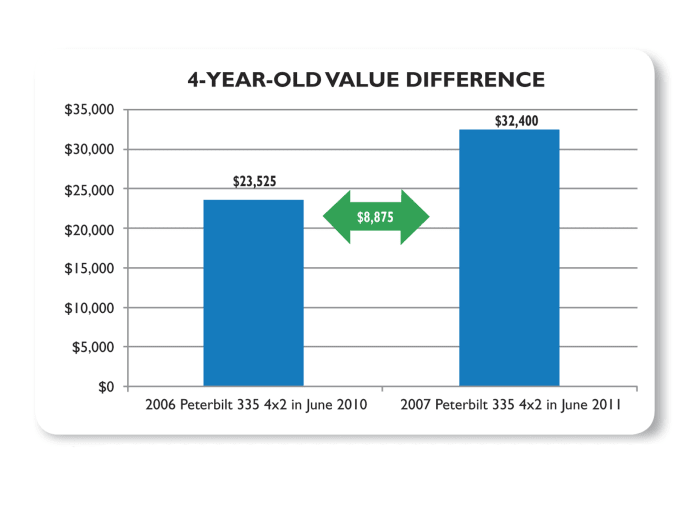
The increase in value of the four-year-old models, year-over-year, shows the demand and strength of the used-truck market. Values of a four-year-old truck have risen over the last year by $8,875.
Sourc: GE Capital Fleet Services
To capitalize on the strong used-truck market, some fleets are short-cycling medium-duty trucks. One such fleet is Joy Global. "We have chosen to short-cycle our medium service truck fleet at three to four years in service versus our normal five- to seven-year cycle. As a result, our depreciation has dropped to approximately 1.5 percent per month," said Butsch of Joy Global.
The key trends influencing resale values of medium-duty trucks today and into the future are the economy, technology, and aging fleets.
"As the economy continues to improve, so will the demand for both new and used trucks. New-unit orders are increasing, but it will be a while before they have any impact on the current shortage of used trucks," said Mark Orth, national remarketing manager, truck & specialty assets for GE Capital Fleet Services. "Another key trend is technology. Customers are looking for better fuel efficiency and lower operating costs. Manufacturers able to incorporate new technology into their trucks and become proven performers will reap the benefits. The marketplace will reward them with strong demand and higher resale values."
Storz of ARI believes the biggest impact on used-truck resale values is the limited availability of low-mileage trucks due to the increased number of higher-mileage trucks entering the wholesale market.
In the current wholesale market, one of the biggest changes has been the age and mileage of medium-duty trucks being remarketed compared to the past several years.
"Many customers are extending months in service and mileage on medium-duty trucks. It is not uncommon to sell medium-duty trucks today with 200,000, 300,000, 400,000, or more miles on them," said Orth. "Until recently, the Class 8 tractor was considered high mileage at 500,000. Now, that number has moved closer to 700,000 miles. This change has also carried over to the medium-duty trucks."
Others cite another vehicle condition as the primary factor influencing resale value. "As always, clean, well-maintained vehicles in good repair will always bring a premium over the same vehicle that does not look as good, even if it has substantially less mileage than the good-looking truck," said Keig of NCH EcoServices. "In addition, there has been a demand of late for good, clean vehicles to counter the increased cost of 2010 emissions-compliant new equipment."
The economic downturn was the key factor prompting truck fleets to extend vehicle service lives.
"The overall mileage on the used trucks is slightly higher due mainly to the trucks being used for extended periods in various fleets with the longer trade-in cycles. With many businesses being down, thus new orders being non-existent, the units are staying in service longer and are getting more usage," said Beggs of Black Book.
Many of the negative connotations associated with older fleet units are not as critical in the medium-duty market.
"While there are more and more medium-duty truck owners each year who understand the potential economic feasibility of cycling vehicles out at an appropriate time/mileage band, there are a number of owners who either cannot afford to do so or do not agree with standard industry practices. This can especially hold true for specialty upfit vehicles. Contrary to conventional wisdom, many times, extended lifecycling can pay good dividends," said Keig. "Solid arguments can be made that company image, customer commitments, and any unscheduled downtime mean different values to different fleet managers, especially in centralized or decentralized operations or with or without in-house shop resources."
Inventory Shortage of Used Medium-Duties
The inventory shortage for medium-duty vehicles in the wholesale market, similar to the current shortage for light-duty vehicles, is forecast to persist for the next several years.
"The lack of new units ordered from 2008 to 2010 has caused an extreme shortage of quality used equipment. This, coupled with tight credit and cautious buyers targeting used equipment, contributes to higher residual value," said Butsch of Joy Global.
Concurring with this observation is Beggs of Black Book.
"The inventory shortage is definitely present for medium-duty used vehicles, just as in the car and light-duty market. Buyers of these models are more need-based, rather than making impulse purchases in the auto industry. The lending trends of three years ago being so much tighter has also created fewer repossessions today, adding to the shortage that exists," said Beggs. "Model configuration is also a driver of retention value. A regular version, as compared to a crew cab configuration, might show a different level of retention. There is a wide variance in new cost between the regular and crew cab models by manufacturer, which will affect used value retention. This is just another example of the importance of being specific when tracking values. Add in the variance of markets, even by the dealer and his or her specific retail market, and the trends will often vary."
The outlook is that the shortage of medium-duty truck inventory in the wholesale market will continue for the next several years, especially for lower-mileage units.
"There is a shortage of late-model, clean, low-mileage, medium-duty units under 100,000 miles. If you look back two, three, and four years ago at the double-digit declines in new medium-duty truck sales, you realize it may be a while before we work out of the current shortage. There is no shortage of older, high-mileage, old technology units, and the demand has improved slightly, but they are still difficult to sell," said Orth of GE Capital Fleet Services.
Late-model, low-mileage trucks are commanding a resale premium, added Storz of ARI.
As demand exceeds supply, the inventory shortage has exerted upward pressure on medium-duty resale values.
"Our resale values are higher than they have ever been. The lack of new units ordered from 2008 to 2010 has caused an extreme shortage of quality used equipment. This, coupled with tight credit and cautious buyers targeting used equipment, has all contributed to higher residual value," said Butsch.
However, the inventory shortage is more pronounced in certain geographic regions, along with other market forces.
"This depends on both the geographic area and also the specific type of truck that is being pursued. This also is dependent on whether one or two major fleets release a significant number of similarly equipped vehicles during a short time period or in one market area," said Keig of NCH EcoServices.
Regional Variations on Medium-duty Resale Values
Generally, regional differences in resale value strength are nominal. The Internet has helped minimize regional pricing variation across all vehicle classes, including medium-duty trucks.
"There are very few regional differences in the strength of the resale market for late-model, low-mileage, or specialty trucks. With the shortage of good, clean, late-model trucks, buyers are reaching out across the country to find the trucks they need. More of today's buyers are buying because they have a prospect or sale for the unit versus buying to stock inventory," said Orth of GE Capital Fleet Services.
However, regional demand for certain vocational trucks is reflected in pricing.
"There are some geographic pockets on certain types of trucks that seem to be in slightly more demand, such as some landscape-type trucks in the Florida market. With many dealers traveling across larger areas to find trucks, along with the ability to access auctions online to find the specific trucks in need, the variance by region has decreased over time," said Beggs of Black Book.
Also, regional weather conditions affect overall vehicle condition, which in turn influences pricing.
"One regional factor is vehicle condition, especially on older units. Units located in the Northern rust-belt states often show the effects of the environment, whereas units operated in the Southern and Western states do not. Both buyers and sellers recognize this, and prices will reflect vehicle conditions. Natural disasters may also have a short-term regional impact on resale values," added Orth.
Keig of NCH EcoServices makes a similar observation. "Typically, vehicles in the South command a stronger resale simply due to their condition, which is an indication of both the roads and environment that they are exposed to. Some of the anti-icing/salt substitutes that are being used are horrendously corrosive to vehicles and their components and will 'age' a truck in quick fashion," he said.
Long-Term Forecast of Medium-Duty Resale Values
The expectation is that medium-duty resale values will remain strong due to limited inventory through the balance of 2011 and well into 2012.
"The remainder of 2011 will remain strong, and 2012 should be another strong year for medium-duty trucks. New-home construction is a major source of employment, and as this industry comes back, the demand for trucks will only increase," said Seger of GE Capital Fleet Services.
In addition, the extreme shortage of quality used equipment will continue. Demand for good-condition, lower-mileage medium-duty trucks will continue to outpace supply. There are plenty of older, higher-mileage medium-duty trucks, but they are more difficult to sell.
"We think the used medium-duty market will continue to be solid with even some slight increases in values on some models throughout the remainder of 2011. This is all being driven by the limited supply from which to choose, as well as some users attempting to hold back their costs by purchasing used as compared to higher-priced new models," said Beggs of Black Book.
Similarly, Storz of ARI foresees the wholesale market remaining very strong for clean, low-mileage trucks.
The wild card is the construction industry, which has traditionally been a major purchaser of medium-duty products. Presently, the market is sluggish, but ultimately, pent-up demand will put upward pressure on new construction, which in turn will help stimulate medium-duty sales. Everyone agrees that medium-duty truck resale values will strengthen when the new-construction market rebounds. Many used-truck buyers in the construction market are deferring purchases until a turnaround occurs.
"If the economy continues to heat up, I believe we will see a tight market on all Class 3-7 vehicles through 2012. Companies that have access to cash will continue to purchase, extending build times," said Butsch of Joy Global.
For the balance of this year and into the 2012 calendar year, there will be a shortage of desirable medium-truck inventory in the wholesale market, keeping resale prices strong. The question is whether prices will remain at current levels as the volume of used inventory in the wholesale market begins to increase.
"It is very difficult to say when inventory in the wholesale market will start to increase; however, it should remain strong given the increased cost of new trucks, and many owners still have credit or funding challenges. Many companies still are very conservative and very cautious with self-funding," said Keig of NCH EcoServices.
Orders for new medium-duty trucks have been increasing, putting units in the pipeline to ultimately replenish wholesale inventory; however, these units won't enter the market for another decade. What will be entering the wholesale market are the older units these new models are replacing. Unless a company is expanding its fleet, the more new units it acquires, the more older units it replaces and remarkets in the wholesale market.
Although still anemic, nationwide economic activity is improving. Historically, sales of Class 4-5 trucks have been a bellwether for the future vitality of overall medium-duty truck sales (Class 3-7), based on the industry's experience emerging from past recessions. For instance, when the truck industry emerged from the 2001 recession, sales of Class 4 and 5 GVWR models were 35% higher than those of Class 6 and 7 trucks. Also, today's high diesel fuel prices make companies more receptive to downsizing to smaller, more fuel-efficient Class 4-5 trucks.
"One trend that will follow the 'new-vehicle side' is that there will be a continuing increase for automatic compared to manual transmissions. Vehicles with basic driver comforts, such as air conditioning, cruise control, electric windows/locks, and air ride seats, will continue to command strong prices. It is hard to believe that it was not long ago when these items would never have been considered a spec on a new truck. Trucks with available air-ride suspension typically command stronger resale than conventional spring suspension," said Keig. "The trend of removing specialty upfit or equipment from the old chassis and installing it on the new one, thereby selling the old chassis-cab by itself, has been leveraged for many years and will continue to be a viable solution to many fleet managers."
Subscribe to Our Newsletter
More Remarketing & Lifecycle

AP Fleet Management Expands Remarketing Program for Commercial Work Trucks
AP Fleet Management expanded its commercial vehicle remarketing program with dedicated resale services and an online marketplace for used work trucks.
Read More →
REP Inspection Services Launches, Delivering Professional Equipment Inspections
REP Inspection Services, led by someone with more than 30 years of industry experience, has launched its professional inspection services for trucks, trailers, and equipment across the commercial vehicle industry.
Read More →
Introducing Work Truck’s 2025 Remarketing Report Series
Work Truck’s 2025 Remarketing Report Series uncovers how data, timing, and technology are reshaping resale value and driving smarter fleet strategies.
Read More →
Fleet Remarketing Outlook 2026: EVs, Policy, and the Power of People [Part 4]
From EVs to policy changes, the 2026 fleet remarketing outlook is all about people, progress, and finding opportunity in stability.
Read More →
Digital Fleet Remarketing: How Tech and Transparency Build Buyer Confidence [Part 3]
Technology and trust are reshaping fleet remarketing in 2025. See how data, transparency, and partnerships drive better resale outcomes.
Read More →
Fleet Replacement Strategy 2025: When to Hold and When to Fold [Part 2]
Knowing when to sell or hold is key in 2025. Discover how fleet professionals use data and TCO insights to make smarter remarketing calls.
Read More →
The 2025 Work Truck Remarketing Market: Prices, Pressure, and What Comes Next [Part 1]
Fleet remarketing in 2025 is stabilizing. Experts share how prices, rates, and new tech are shaping used truck values and resale strategies.
Read More →
Copart and One Inc. Partner to Improve Auto Claims Process
ChatGPT said: One Inc and Copart partner to speed up lienholder payments, helping insurers process total loss vehicle claims faster and improve customer experiences.
Read More →
Fleet Remarketing Industry Council Launches to Shape Future Resale Value
What if fleets could shape how their vehicles are valued after resale? Now they can.
Read More →
CAR Partners with NAFA Fleet Management Association For 2026 Event
The event will connect fleet managers with vehicle remarketers to delve into topics that help fleet operations find remarketing solutions.
Read More →