





For Free: Digging into Work Truck Fleet Costs
Medium-Duty Operating Costs Increase in 2008-CY
The biggest factor behind the spike in medium-duty operating costs was the increase in diesel prices, which jumped 32 percent from the then-historical high in 2007. Other factors included increased labor rates and higher taxes.
April 22, 2009
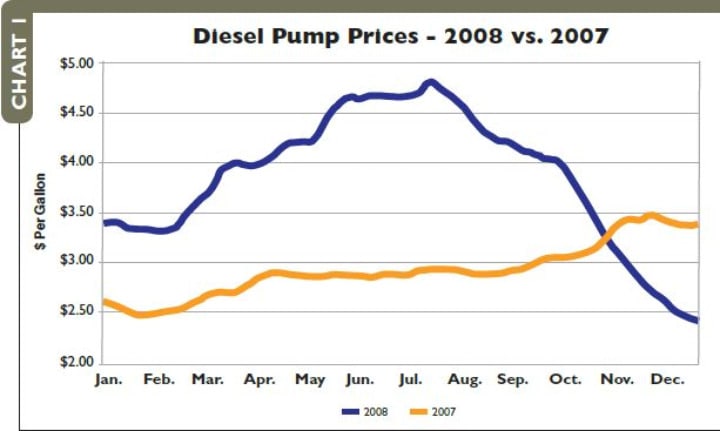
Average U.S. diesel pump prices, calendar-years 2007 and 2008.
Photo: PHH
9 min to read
Key factors that influenced medium-duty truck operating costs in 2008 were the price of diesel, increased repair costs related to new truck technologies, higher labor rates, and decreased utilization. However, fuel was the primary driver behind higher operating costs in the 2008 calendar-year.
"Clearly, the biggest, most significant factor influencing operating costs in 2008 was the leap in diesel and gasoline pump prices," said Greg Stanford, senior business consultant for PHH Arval. "For the 2008 calendar-year, U.S. diesel averaged $3.87 per gallon and peaked at over $4.75 per gallon last July. This is despite never having been over $3.25 per gallon before November 2007. The result is that fuel operating costs alone rose by over 32 percent from historically high 2007 levels."
Fuel costs in the 2008 calendar-year averaged $0.387 per mile for typical Class 3 and 4 trucks and $0.48 per mile for Class 5 and 6 trucks.
"At peak diesel prices, these values topped $0.47 and $0.59," said Stanford. "Viewed another way, consider annual fuel costs for 25,000 miles and what might have been a budget for $3 per gallon fuel. Higher pump prices resulted in a budget overrun of $2,100 to $2,700 for each vehicle, depending on fuel economy."
These costs would have been even worse had fuel prices not collapsed last fall.
"At the beginning of spring 2009, diesel prices are near or even below $2 per gallon in some areas, almost half where they stood at this same time last year. Certainly this is welcome news from an operating cost standpoint, but it comes as a result of decreased business volumes associated with the economic slowdown," said Stanford.
According to PHH, for the remainder of 2009, pump prices may continue to rise and fall with the strength of the economy. "The March forecast from the Department of Energy for diesel fuel is $2.19 per gallon for 2009 and $2.51 per gallon in 2010. However, a return to robust economic conditions will likely bring a return of higher diesel prices as well," added Stanford.
Truck Operating Trends
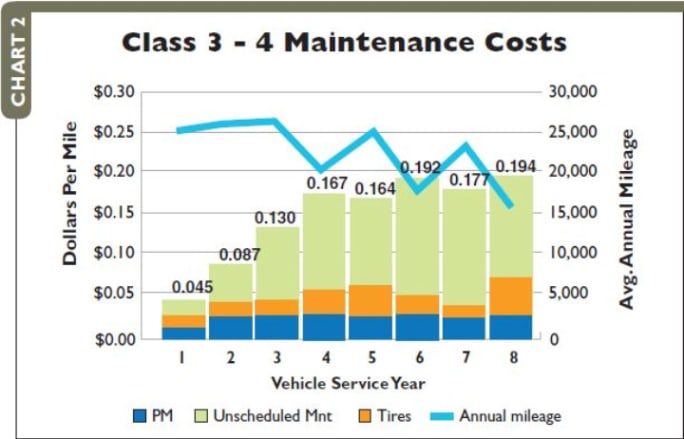
2008 maintenance costs and vehicle utilization by years in service, Class 3-4.
Photo: PHH
In recent model-years, a variety of new technologies have been offered on medium-duty trucks. These devices are introducing new expenses. "This includes repair costs related to new truck technologies such as APUs, hybrid devices, more complex transmissions, and other electrical components not previously available on trucks," said Steve Byrd, fleet services manager for PHH Arval and a Certified Transportation Professional.
Other trends that will influence operating costs in 2009 and beyond are vehicle utilization, replacement tire costs, labor rates, and new environmental regulations.
"The economic slowdown has resulted in many fleets, particularly delivery fleets, seeing a drop in their vehicle utilization," said Stanford. "Fewer deliveries lead to fewer miles, and in some instances, the need for fewer trucks. So a key area in cost management over the next year will be properly managing fleet resources to what are likely lower levels of demand. Decisions made this year on the capital budget side will impact operating costs many years into the future. Trying to 'save' money by delaying vehicle replacement will only result in higher maintenance and associated downtime costs later on."
The high cost of replacement tires is prompting some fleets to increase use of retreads.
"We saw a lot of tire price changes in 2008, especially in the first half of the year. For the entire year, tire costs rose about 6 percent overall, which influenced some fleets to start looking closer at recaps for at least a portion of their fleet," said Charlie Thomas, manager, PHH Vehicle Maintenance Assistance.
Maintenance costs are also experiencing upward price pressures due to rising labor rates. "Preventive maintenance (PM) costs relating to the individual parts items have risen a small amount, but the labor and other costs associated with PM services rose about 11 percent. Average tax rates also rose about 1 percent in 2008," said Thomas. "As we see the first vehicles equipped with diesel particulate filters (DPFs) gaining higher mileage, we are starting to see some costs associated with repairs and maintenance to these systems. This will probably be factored into costs even more in the future, as trucks with SCR (selective catalytic reduction) systems and advanced EGR (exhaust gas recirculation) systems start hitting the road to meet 2010 emissions standards."
Longer truck service life is another reason maintenance costs are forecast to rise. "New truck sales have slowed in the past year, so this will increase the maintenance operating costs of vehicles that would have otherwise been replaced," said Byrd.
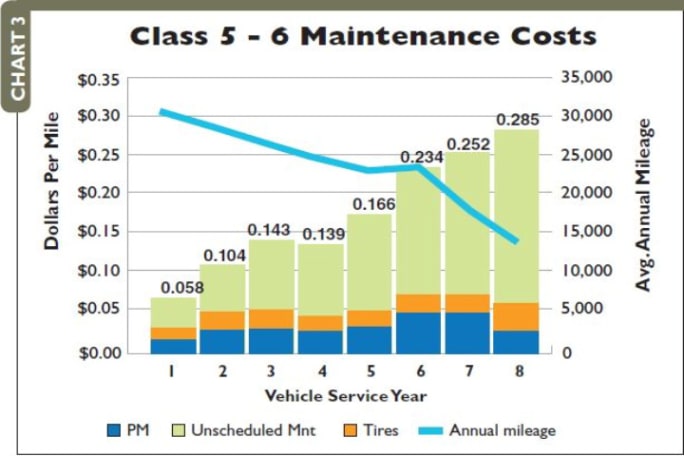
2008 maintenance costs and vehicle utilization by years in service, Class 5-6.
Photo: PHH
In addition, the 2010 emission standards will introduce entirely new maintenance items, plus increase the initial acquisition cost of trucks.
"New tighter emissions in 2010 will increase the price of new vehicles, increase their weight, and may cause reluctance to buy new vehicles. Larger classes of vehicles will use SCR and urea solutions - another addition to operating costs," said Byrd.
The volatile price of commodities, such as steel and aluminum, will have still another impact on truck costs.
"Most medium-duty trucks have bodies, and the rising cost of material surcharges in commodities has increased the cost of bodies," said Ezel Baltali, fleet services applications engineer for PHH Arval. "If the bodies are refrigerated, these bodies need a reefer unit. We believe the cost of these additions to the chassis will remain high, especially with so many competing companies. Many body companies now offer their own reefer systems. Rather than install as a separate item, a company may purchase a body at a premium price, fully functional as a reefer system."
Environmental Regulations
New regulatory requirements will put upward pressure on fleet maintenance and upfit costs.
"With new emissions measures, new components come into play for maintenance and repairs, along with the cost of upfits for regulatory purposes," said Baltali.
This trend requires fleet managers to stay on top of manufacturer equipment requirements relating to new emissions standards.
"Whether on new equipment or in making any retrofits that might be required by local or national legislation, this emissions equipment is expensive and will impact overall fleet operating costs," said Stanford. "In many respects, California leads the nation in environmental issues, and complying with the proposed California Air Resources Board (CARB) reporting requirements for medium-duty trucks will be an added burden to fleet managers."
These regional environmental regulations impact not only local fleets, but also nationally dispersed fleets.
"The proposed CARB requirements will affect over-the-road truck units with a 14,000 lbs. GVW and greater. CARB affects any units operating in California with an engine older than 2010 or without 2010 emissions," said Thomas. "With the CARB proposal, fleets in California must upfit vehicles in order to obtain compliance, starting Jan. 1, 2011." These upfits can range from $15,000-$20,000 per unit, including installation and filters.
"A fleet may either upfit or replace to obtain compliance. If a company decides to upfit, it pays for new technology and labor, along with the higher cost-per-mile with aging equipment," said Baltali. "The used-truck market also takes a hit, as owner-operators purchasing a used truck will need to upfit to be compliant. Most major truck and engine OEMs offer a solution for upfitting."
Macroeconomic Impact
The national macroeconomy is an uncontrollable factor that will continue to exert a strong influence on truck fleet costs. "These cost trends will undoubtedly continue as the economy struggles. Fleets are tending to delay new-vehicle purchases and keep existing fleet vehicles in service longer, which adds to the long-term maintenance and repair costs, especially as more powertrain components fall out of warranty terms," said Thomas.
However, it is important truck fleet managers stay focused on lifecycle costs.
"Even though the state of the economy is uncertain, it's important to keep your fleet aging and lifecycle values pure. Otherwise, you'll lose control of several key benefits. To do this, you must determine your optimum lifecycle," said Byrd. "Optimum lifecycles include determining the 'sweet spot' for replacement. You will need to look at original capital cost, cost of capital, per-year maintenance costs, utilization, residuals, and business plan. If that magic number equals, say, six years and you have 100 trucks, you should replace 16 or 17 trucks every year to keep your operating costs as low as possible. The discipline is not easy, but it is critical."
5 Ways to Lower Operating Costs
Here are five actions fleet managers can take to lower the operating costs of their medium-duty truck fleets.
1. Update PM Schedules
"There have been a lot of technology changes in the past decade, but we sometimes still see PM schedules that haven't been reviewed or changed in years," said Charlie Thomas, manager, PHH Vehicle Maintenance Assistance. "For example, as platinum spark plugs changed how we think about tune-up intervals, advances in synthetic fluids and extended drain intervals should be considered when drawing up a PM 'A' or PM 'C' annual inspection."
Thomas sometimes see a client or a shop present a PM schedule with a manual transmission or differential drain required at 30,000 miles or annually, and the truck in question has synthetic gear oil in the axle, which has a drain interval of 150,000 or even 500,000 miles.
"Reviewing all of the PM requirements to meet the needs of a fleet's current vehicle inventory should be a regular practice. Maintenance is essential, but over-maintaining raises fleet costs and is detrimental to the environment," added Thomas.
2. Driver Pre-Trip Inspections
"The DOT requires daily driver vehicle inspection which can generate fines if not completed," said Thomas. We recommend that you enforce procedures for taking corrective actions on items which fail inspection, to avoid fines and possible breakdowns.
3. Enforce PM Compliance
PM compliance will also help reduce incidents of unscheduled maintenance. "Closely manage your PM compliance to reduce costly unscheduled maintenance events that typically have premium fees, such as towing, roadside service, or after-hours surcharges," said Steve Byrd, fleet services manager for PHH Arval. "Consider curtailing onsite PM services, which often include service fees for technician driving time. Local dealers looking to increase their service department activity may be willing to offer free pickup and delivery or walk-in service."
4. Reduce the Number of Preventable Accidents
"Increase driver safety training to reduce preventable accidents. Also, see if you are able to downsize your fleet rather than hanging on to 'spare' units to hedge against accidents and high rental costs," said Byrd.
5. Track Costs by Maintenance Codes
"Tracking costs internally through specific maintenance codes can give a fleet manager a key view of where specific costs lie," said Ezel Baltali, fleet services applications engineer for PHH Arval. "If a fleet manager sees his fleet has higher-than-average transmission costs, see what new options may be implemented for the new order. Don't focus only on the main areas, such as engine, transmission and brakes, which are oftentimes warrantable, but also examine the cranking, charging, fuel, PTO, and exhaust systems for potential savings."
Subscribe to Our Newsletter
More Operations

What Does a Potato Have to Do with Leadership?
From simple process improvements and creative problem-solving to the little moments that strengthen team culture, this conversation dives into the power of unexpected ideas and why innovation doesn't always arrive wrapped in new technology or a major initiative.
Read More →
Looking for a New Podcast for the Road? Start Here!
Looking for a new podcast? Truck Chat delivers fleet leadership insights, industry deep dives, AI discussions, innovations, and real-world stories.
Read More →
Did You Know What You Don't See May Be Costing You Big?
As more employees choose personal vehicles (including hybrids and EVs) for business use, companies face new challenges around visibility, insurance, liability, and cost control.
Read More →

Veteran Voices in Fleet | How Military Service Shapes Fleet Leaders
Across every perspective, one message is clear: the experiences gained through military service continue to influence how veterans contribute to the fleet industry every day.
Read More →
The Fleet Lessons That Don’t Show Up on a Spreadsheet
From index cards to predictive maintenance, Robert Martinez shares the hard-earned leadership lessons that shaped nearly 40 years in fleet.
Read More →
People, Leadership & the Skilled Trades Opportunity | Weekly Cheat Sheet
People, data, leadership, and the skilled trades opportunity. See what's shaping fleets today in this week's Truck Chat Weekly Cheat Sheet.
Read More →
Everyone Thinks They’re a Fleet Manager
From oil changes to procurement decisions, fleet work is often underestimated by the very people who depend on it most. Bob Stanton makes the case for why communication, not just technical expertise, is one of the most important leadership skills in fleet.
Read More →
Sponsored•June 1, 2026
Turning Connected Vehicle Data Into Decisions That Matter
Fleet leaders have more data than ever, but turning that data into clear, actionable decisions remains a challenge. This white paper shows how leading organizations are using connected vehicle data to improve safety, reduce costs, and optimize fleet performance. Learn how to turn insight into action across your fleet.
Read More →
From Military Service to Fleet Leadership | Shades of Fleet
Military service ends, but the lessons don't. Hear how veterans are shaping fleet leadership through adaptability, teamwork, and mission-driven thinking.
Read More →
Sponsored•May 29, 2026
Are You Tracking Your Fleet's True Total Cost of Ownership?
Bobit Business Media surveyed 190 fleet professionals and found that while most fleets are tracking costs, fragmented systems and data gaps are keeping true TCO visibility out of reach. With rising pressure to control spend in an increasingly volatile environment, the gap between what fleets think they know and what the data actually shows is wider than you might expect. See how your peers are managing costs today and where the industry still has room to improve.
Read More →