




Freightliner M2e Hybrid Gets Down to Business
With improved fuel economy, lower emissions, extended brake wear, and reduced idle time, Freightliner’s Business Class M2e Hybrid offers fleets a “clean” way to get the job done.

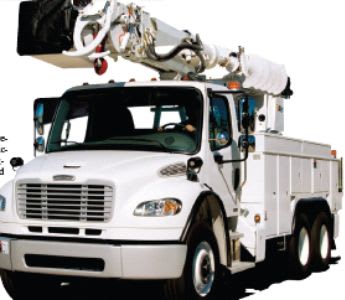
Particularly suitable to utility applications, the M2e’s engine shuts off and the electric motor powers tools and hydraulic lifts.
Photo: Freightliner
With the Freightliner Business Class M2e Hybrid, Freightliner Trucks, a Daimler Trucks North America division, has taken a step toward Daimler’s goal of producing a zero-emissions vehicle. With fuel savings up to 1,500 gallons per vehicle, longer brake life, quiet electric power takeoff (ePTO), and idle time reduced by as much as 87%, the M2e Hybrid skips the nonsense so fleets can get down to business.
Built for stop-and-go operations, the Freightliner Business Class M2e Hybrid features the Eaton Parallel Electric Hybrid drivetrain system, tested over four years and 2 million miles. The parallel electric hybrid system allows fleets to operate with just the diesel engine or in combination with the hybrid electric motor. The diesel powertrain remains fully functional in the unlikely event the hybrid drive unit goes offline.
The hybrid motor provides additional power to launch the vehicle and improves fuel economy in high stop-and-go operations, ideal for utility, towing, pickup and delivery, and beverage applications.
Regenerative braking captures about 70% of the kinetic energy produced, recharging the hybrid’s battery. Energy normally lost during braking is stored in the batteries. Regenerative braking saves fuel, extends brake use, and allows for continual battery recharge in stop-and-go driving.
The truck’s hybrid drive power not only enhances fuel efficiency but also provides an added boost for hills or rapid acceleration, helpful for vehicles that make frequent stops.
Stored energy also powers electric-only operation for ePTO and auxiliary power generation. Particularly suitable for utility applications, the M2e’s engine shuts off, and the electric motor powers tools and hydraulic lifts. Fleets can save fuel, while quietly reducing emissions and idling. Electric-only ePTO operation provides a significant reduction in emissions and idle time and also offers operating flexibility.
Attractive Features All Around
The M2e is equipped with a number of money-saving qualities.
Extended wear. The Freightliner Business Class M2e Hybrid’s engine and brakes now last longer. Brake life is more than doubled in urban delivery services, according to the company.
Reduced idling. In ePTO mode, idle time can be reduced by as much as 87 percent. Less idling means less fuel, exhaust, heat, noise, and vibration. In utility applications, 4-5 hours of idle time per day can be eliminated.
Fuel economy. With the city delivery vehicle, fuel economy is improved from 25 to 40 percent. Fuel economy in utility applications has seen a 40- to 60-percent improvement.
Overall annual savings. Considering fuel economy, extended brake life, and federal tax credits, city delivery and utility fleets can achieve an annual savings of $3,500-$6,000. Both state and local governments offer a number of incentives to offset the cost of the new technology.
Other standard features on the M2e include:
Increased visibility with a broad windshield and sloped hood.
Enhanced maneuverability with up to a 55-degree wheel cut.
A roomy interior, featuring an automotive-style dash.
Large doors, easy ingress and egress, with low step-in height.
Adaptable cab configurations with standard multiplex wiring, clear frame rails back of cab, and a variety of horizontally and vertically mounted exhausts.
Lightweight aluminum cab and easy maintenance.
More Green Fleet
Landi Technologies Achieves CARB Certification of Ford 7.3L RNG/CNG Platform
Landi Technologies has gained CARB certification of its Ford 7.3L Renewable Natural Gas (RNG) and Compressed Natural Gas (CNG) platform for the Ford E-450, F-450/550/600, F-650/750, and F-53/59 platforms.
Read More →
Turning Connected Vehicle Data Into Decisions That Matter
Fleet leaders have more data than ever, but turning that data into clear, actionable decisions remains a challenge. This white paper shows how leading organizations are using connected vehicle data to improve safety, reduce costs, and optimize fleet performance. Learn how to turn insight into action across your fleet.
Read More →
Are You Tracking Your Fleet's True Total Cost of Ownership?
Bobit Business Media surveyed 190 fleet professionals and found that while most fleets are tracking costs, fragmented systems and data gaps are keeping true TCO visibility out of reach. With rising pressure to control spend in an increasingly volatile environment, the gap between what fleets think they know and what the data actually shows is wider than you might expect. See how your peers are managing costs today and where the industry still has room to improve.
Read More →
Epic Charging Acquires Bluedot Technologies
Epic Charging has acquired Bluedot Technologies, expanding EV fleet charging access to more than 80% of U.S. public charging networks.
Read More →
CALSTART Adds 64 New Sites and Features to Its Medium- and Heavy-Duty Zero-Emission Infrastructure Map
CALSTART’s interactive National Medium- and Heavy-Duty Zero-Emission Infrastructure Map now locates approximately 1,500 ports at 162 total public, semi-public, and shared electric vehicle (EV) charging and hydrogen refueling facilities for Class 2b-8 trucks.
Read More →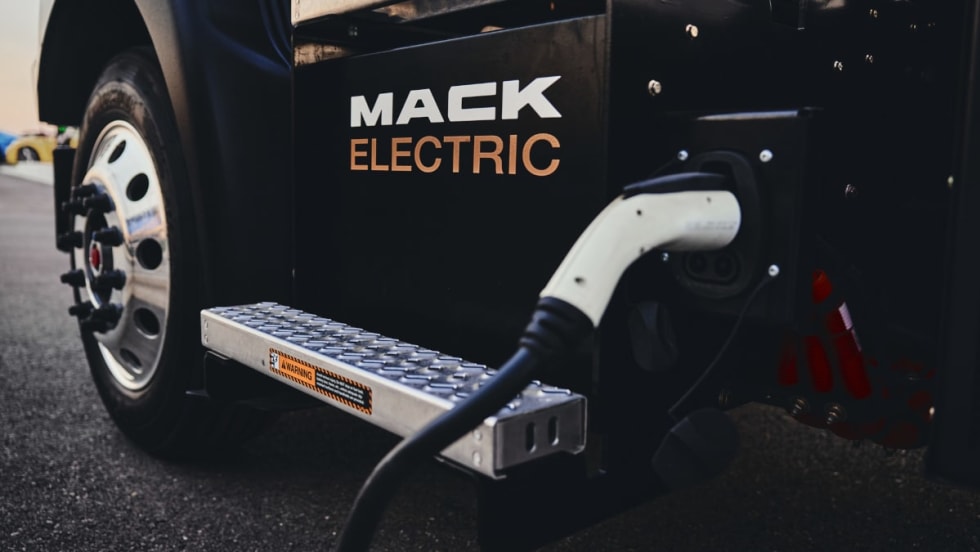
Mack Trucks Expands Full-Service EV Infrastructure Providers
Mack Trucks has expanded its comprehensive Turnkey Solutions program for Mack battery-electric vehicle customers with the addition of two new full-service providers, ABM and Lane Valente Industries.
Read More →
EV Realty Opens Major Truck Charging Hub in California’s Inland Empire
EV Realty’s San Bernardino Powered Properties’ truck charging hub, which has now opened, can serve over 200 medium- and heavy-duty trucks per day.
Read More →
WEX Launches Solution to Close the EV At-Home Charging Visibility Gap for Fleets
WEX unveiled its EV At-Home with Vehicle Fraud Protection, which ensures accurate and secure reimbursement for at-home charging.
Read More →
Toyota Motor Corporation to Join Daimler Truck & Volvo Group in Fuel Cell Joint Venture Cellcentric
Toyota intends to join Daimler Truck and Volvo Group as an equal shareholder in Cellcentric. All three shareholders intend to further strengthen Cellcentric as a leading manufacturer of fuel cell systems for heavy-duty commercial applications.
Read More →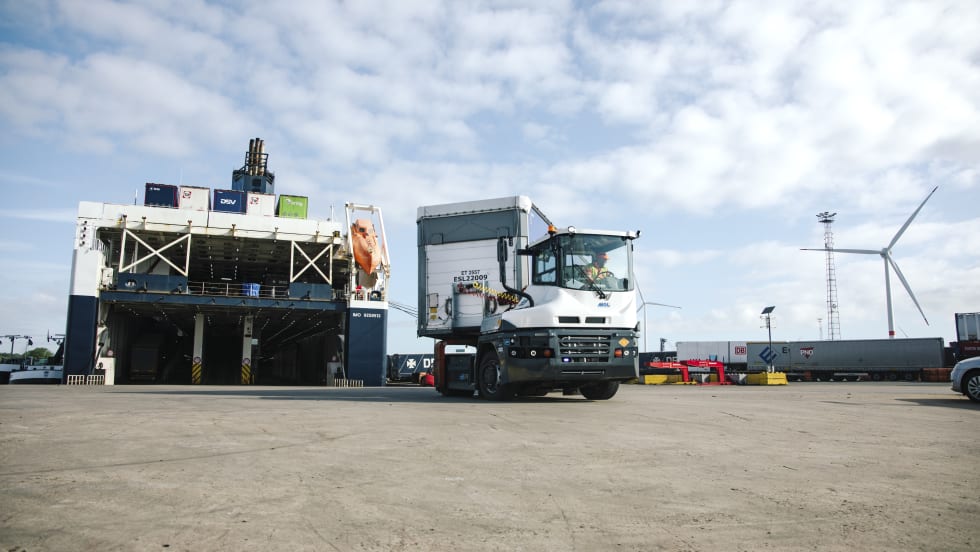
Volvo Penta Electric Drivetrain Powering Terminal Tractors
Volvo Penta and Volvo Financial Services (VFS) have partnered to support one of Northern Europe's largest shipping and logistics companies in its ambition to transition to electric terminal tractors.
Read More →