



Miss This? Comparing Alt-Fuel Costs
Bakery Goes Green to Save Green
For Rossmoor Pastries, converting from gasoline-powered delivery vans to a fleet fueled by clean-burning compressed natural gas is saving the company $4,000 per month.
by Joan Shim
May 1, 2008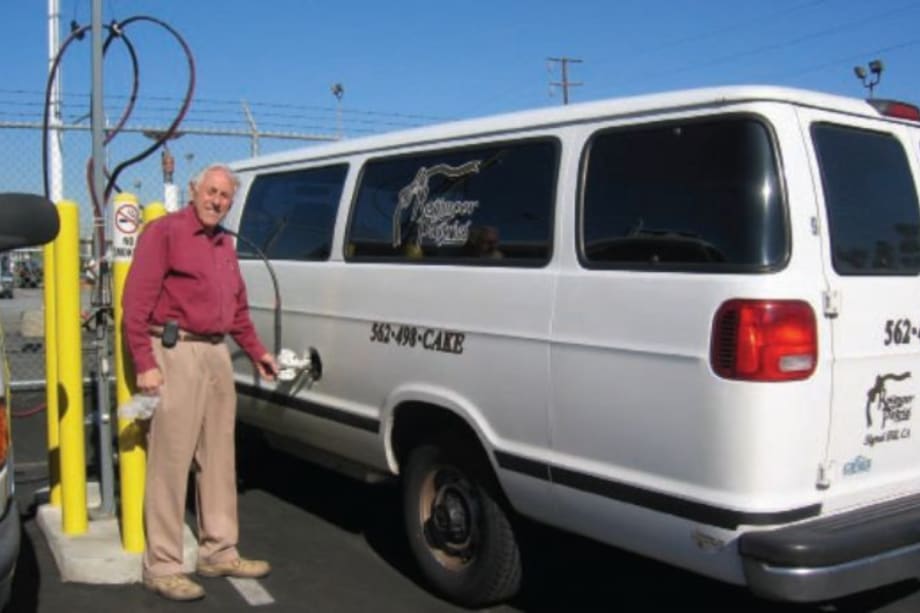
Charles Feder, owner of Rossmoor Pastries, found his dedicated compressed natural gas vehicles at auto auctions.
Photo: Rossmoor Pastries
5 min to read
Charles Feder, owner and operator of Rossmoor Pastries in Signal Hill, Calif., stumbled upon a goldmine when he purchased his first natural gas vehicle (NGV) at auction in April 2006. The dedicated compressed natural gas (CNG) Dodge van, with only 14,000 miles, cost $4,300, while the gasoline-fueled vans were going for around $7,000. Although he wasn’t familiar with NGVs and how they worked, it was a deal he could not pass up.
But the deal did not end there. He saw the major savings potential when he went to a local CNG station. It cost $1.50 per gallon to fill up on CNG, while gasoline was about $2.50 per gallon. As the bakery used up 70 gallons a day on deliveries around Southern California, Feder realized a CNG fleet would immediately realize a savings of $70 per day.
Impressed by the figures, Feder and his business partner Janice Ahlgren purchased eight additional CNG vehicles. They also figured out that they would save big by getting their own fueling system, because the local gas company would sell them natural gas for less than $1 per gallon.
Although the company had to make the initial investment to purchase the vehicles and set up fueling capability at the business, those costs were recovered by April 2007.
While most people in California fret as the price of gasoline nears the $4 mark, Feder smiles on the future. “I’m saving a ton of money, I’m green, and I feel good about what I’m doing,” he says.
Environmentally Friendly Refleeting
Feder found his dedicated CNG vehicles at regular and government auto auctions, which are open to the public. Government vehicles typically have low miles and are well maintained. He purchased six 1999 Dodge passenger vans and two 1998 Ford E-350 vans, each with an average of 30,000 miles. He also bought a CNG Crown Victoria. After buying the NGVs, he sold off his old fleet of Dodge vans for $18,000.
Some minor modifications were made to the vans. The seats were removed and a one-inch insulated floor and racks were installed in the back to carry the bakery items. Feder also tinted the windows and added the company’s logo on the sides of the vans.
Feder anticipates running these vans for a long time, particularly because the fuel burns clean. “These engines last forever. They can go 500,000 miles because they run so clean,” Feder says. “And I don’t burn any oil. The oil lasts 10,000 miles if you want it to.”
Because natural gas vehicles have unique systems, it is crucial to work with a certified CNG mechanic. The National Institute for Automotive Service Excellence (ASE) has a certification test for CNG technicians.
Vehicle manufacturers typically offer the support of trained technicians. Local Clean Cities Coalition offices as well as community colleges and auto mechanic schools may also be able to refer a CNG mechanic.
The vehicle’s manual should include an inspection schedule. Natural gas tanks must be checked regularly and certified by a CNG mechanic, particularly if the vehicle is in an accident. Additionally, “the gap setting is different on the spark plugs, and the O2 sensor must be checked and working properly,” Feder says.
According to Feder, the only roadblock to using a CNG fleet is the limited supply of vehicles. While Honda still sells the Civic GX NGV, most manufacturers are no longer producing them commercially.
The upside is that any vehicle can be converted into a dedicated or bi-fuel NGV. A dedicated vehicle runs exclusively on natural gas while a bi-fuel vehicle has two tanks to run on both gasoline and natural gas. All that is needed, Feder explains, is “a fuel rail, a tank, and a regulator, and you’re in business.”
It would cost around $1,800 to convert a car, he says. However, a converted CNG vehicle may suffer a power loss of 10 to 15%
Fuel Factor
When thinking through his fueling needs, Feder considered how many miles his vehicles would go in one trip. CNG tanks are smaller than gas tanks and his vans can go about 200 miles in one trip. Feder says drivers average between 130 and 170 miles a day delivering cakes, cookies, and sweets around Southern California, allowing a full day of travel without refueling.
“If the vehicles have to go long distances, they have to be in areas where there are refueling stations along their routes,” Feder says. The U.S. Department of Energy (DOE) has a Web site to locate alternative fueling stations.
“My drivers carry a card that has a list of the stations in the area, and most of the trucks have maps of where the stations are,” Feder says.
The DOE reported that in Oct. 2007, the nationwide average price for CNG per gallon was $1.77 at the pump, compared with $2.76 for regular gasoline. Filling up from a compressor that picks up gas from a local pipeline costs even less.
Many types of compressors are available. A simple option is to install a Phill, a refueling appliance made by FuelMaker that taps into a home or building’s natural gas line. FuelMaker says it takes about four hours to fill up the gas needed for 50 miles of driving.
“A small fleet could opt for a couple of those little machines if it fits their requirement,” Feder says. For his fleet of eight trucks, he needed a bigger, more powerful compressor. He had a Bauer compressor installed, which produces the equivalent of seven gallons of gasoline per hour. The compressor is connected to three fill posts that can each fill two vehicles at a time.
Feder says putting in his own compressors at the bakery has been the key to saving money. For the installation, Rossmoor Pastries also secured a funding grant of $18,750 from the South Coast Air Quality Management District (AQMD). Feder applied for the grant through the Alternative Fuel Infrastructure Program.
Cruising the Carpool Lane
If saving tons of money on fuel costs was not enough, owning a CNG fleet comes with additional perks. State and federal tax incentives are offered to NGV owners. Also, in many states, alternative-fuel vehicles can access high-occupancy vehicle or carpool lanes. Vehicle owners must apply for an identification sticker from the California Department of Motor Vehicles. Because Rossmoor Pastries’ drivers can use the carpool lane on deliveries, it saves the company time and money.
Above and beyond the fiscal gains, it is Feder’s contribution to improving the environment that lets him rest easy at night.
“I have grandchildren, and I really want to leave the world a better place for them,” he says. “I feel like I’m doing my part for the environment and I wish more people did.”
Subscribe to Our Newsletter
More Green Fleet
Landi Technologies Achieves CARB Certification of Ford 7.3L RNG/CNG Platform
Landi Technologies has gained CARB certification of its Ford 7.3L Renewable Natural Gas (RNG) and Compressed Natural Gas (CNG) platform for the Ford E-450, F-450/550/600, F-650/750, and F-53/59 platforms.
Read More →
Sponsored•June 1, 2026
Turning Connected Vehicle Data Into Decisions That Matter
Fleet leaders have more data than ever, but turning that data into clear, actionable decisions remains a challenge. This white paper shows how leading organizations are using connected vehicle data to improve safety, reduce costs, and optimize fleet performance. Learn how to turn insight into action across your fleet.
Read More →
Sponsored•May 29, 2026
Are You Tracking Your Fleet's True Total Cost of Ownership?
Bobit Business Media surveyed 190 fleet professionals and found that while most fleets are tracking costs, fragmented systems and data gaps are keeping true TCO visibility out of reach. With rising pressure to control spend in an increasingly volatile environment, the gap between what fleets think they know and what the data actually shows is wider than you might expect. See how your peers are managing costs today and where the industry still has room to improve.
Read More →
Epic Charging Acquires Bluedot Technologies
Epic Charging has acquired Bluedot Technologies, expanding EV fleet charging access to more than 80% of U.S. public charging networks.
Read More →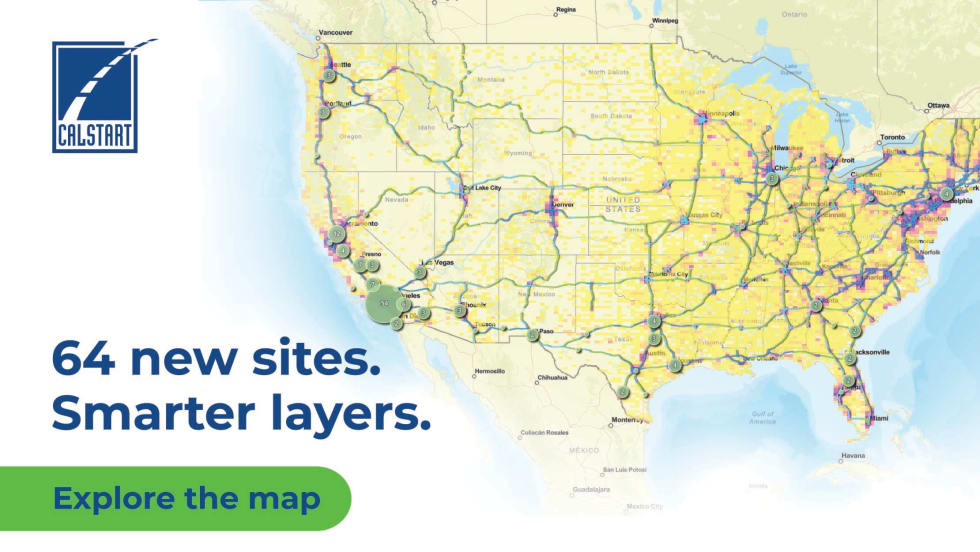
CALSTART Adds 64 New Sites and Features to Its Medium- and Heavy-Duty Zero-Emission Infrastructure Map
CALSTART’s interactive National Medium- and Heavy-Duty Zero-Emission Infrastructure Map now locates approximately 1,500 ports at 162 total public, semi-public, and shared electric vehicle (EV) charging and hydrogen refueling facilities for Class 2b-8 trucks.
Read More →
Mack Trucks Expands Full-Service EV Infrastructure Providers
Mack Trucks has expanded its comprehensive Turnkey Solutions program for Mack battery-electric vehicle customers with the addition of two new full-service providers, ABM and Lane Valente Industries.
Read More →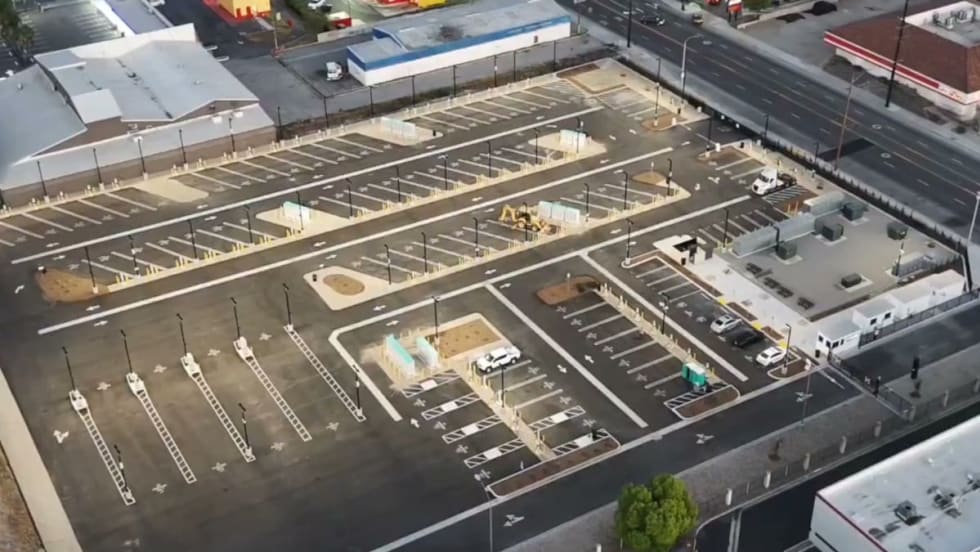
EV Realty Opens Major Truck Charging Hub in California’s Inland Empire
EV Realty’s San Bernardino Powered Properties’ truck charging hub, which has now opened, can serve over 200 medium- and heavy-duty trucks per day.
Read More →
WEX Launches Solution to Close the EV At-Home Charging Visibility Gap for Fleets
WEX unveiled its EV At-Home with Vehicle Fraud Protection, which ensures accurate and secure reimbursement for at-home charging.
Read More →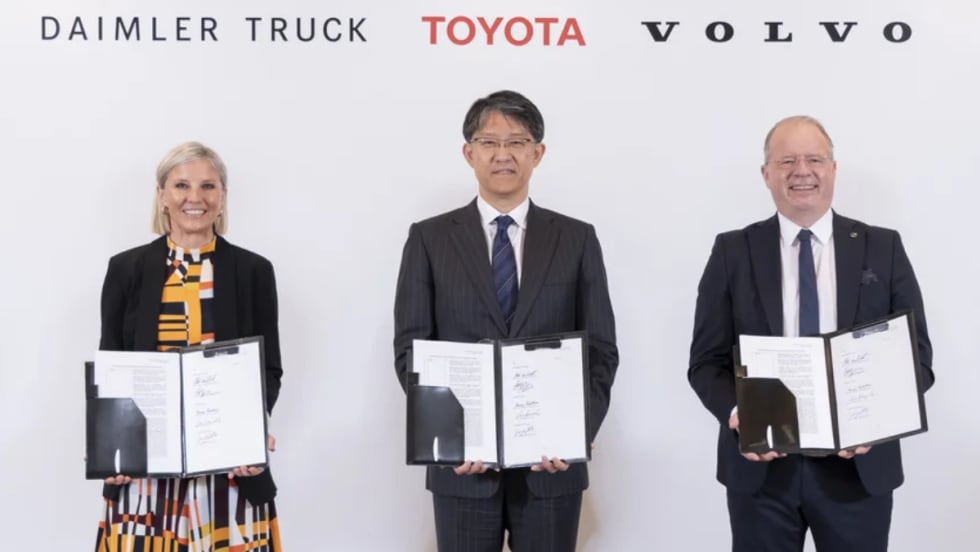
Toyota Motor Corporation to Join Daimler Truck & Volvo Group in Fuel Cell Joint Venture Cellcentric
Toyota intends to join Daimler Truck and Volvo Group as an equal shareholder in Cellcentric. All three shareholders intend to further strengthen Cellcentric as a leading manufacturer of fuel cell systems for heavy-duty commercial applications.
Read More →
Volvo Penta Electric Drivetrain Powering Terminal Tractors
Volvo Penta and Volvo Financial Services (VFS) have partnered to support one of Northern Europe's largest shipping and logistics companies in its ambition to transition to electric terminal tractors.
Read More →