





Dig Deeper: Purolator Hits Road as Electric Courier
Purolator Courier Goes 'Green' with New Electric Delivery Vehicle
Urban package delivery routes usually include lots of stops and starts, but require relatively little long-range driving. Purolator Courier is developing the Quicksider EV, an electric green solution.
January 1, 2008
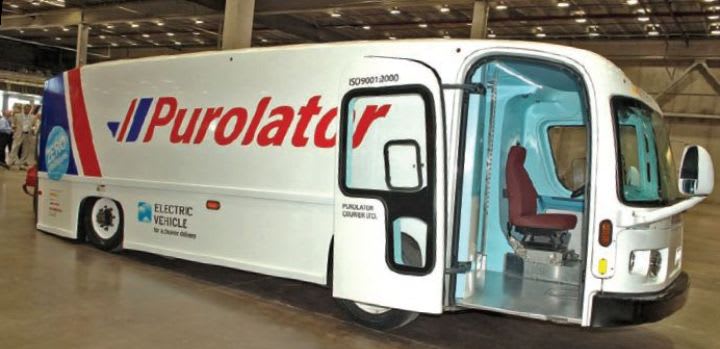
The Quicksider EV delivery van displays its kneeling capabilities during its introduction.
Photo: Purolator
3 min to read
Contrary to popular belief, urban package delivery vehicles spend more time parked while making deliveries or doing pickups than they actually spend on the road. As it turns out, the average delivery vehicle only travels 23 miles a day. Purolator Courier’s new electric vehicle (EV), the Quicksider, fits this kind of driving.
While operating, Purolator’s Quicksider EV is a zero-emission vehicle. Emissions associated with charging its battery are expected to be fewer than 20 percent of those produced by a conventional diesel-powered, curbside delivery vehicle. The Quicksider EV will be tested and evaluated for performance on the streets of Toronto.
Preliminary design work on the Quicksider EV began at Toronto-based Unicell Limited in 2000. In 2003, Purolator joined the development team to provide key insights and recommendations to make the electric vehicle more effective for use in a courier environment.
After analyzing courier routes and terminal operations with Purolator drivers, managers, and engineers, Unicell enhanced its original designs with features to help maximize efficiency in delivery operations.
Drivetrain systems manufacturer ArvinMeritor joined the project team in 2004 to design and build the electric axle drivetrain, regenerative braking system, and system integration of motors, gears, and controls for a working prototype vehicle. The Transportation Development Centre of Transport Canada has also supported the project throughout its development.
High Features & Low Maintenance
The Purolator Quicksider EV combines several operation-enhancing features, including automatic doors, a tight turning radius, and a pneumatic suspension enabling the truck to kneel to curb level to unload packages. With its advanced electric drivetrain, the Quicksider EV is expected to require less maintenance than a conventional diesel-powered curbside delivery vehicle.
The 16-ft. fiberglass-bodied van is built on a stainless-steel chassis and uses a sodium nickel chloride battery that provides a 40-mile range and top speed of 65 mph. Cargo capacity is 10-percent more than a conventional 16-ft. step van. The electric motors in the powertrain deliver a combined 230 hp and are currently powered by a sodium nickel chloride battery pack. Another partner in the program, Electrovaya, is working on a lithium-ion battery pack for testing in the Quicksider EV.
With one-piece body aerodynamics, the van shows half the drag of conventional delivery vehicles, a feature that leads to greater mileage. In fact, during the testing, (traditionally performed by taking a vehicle up to 37 mph, placing it in neutral, and measuring the distance before it stops), officials had to double the length of the testing area to get results.
In addition to the Quicksider EV prototype, Purolator added 30 new hybrid-electric vehicles (HEVs) to its curbside delivery fleet across Canada, with 28 in Vancouver, one in Ottawa, and one in Montreal. The vehicles join Purolator’s national green fleet, which includes 19 HEVs and one fuel-cell hybrid electric vehicle, in service in Toronto since 2005.
Subscribe to Our Newsletter
More Green Fleet
Fuel Management's Next Evolution Centers on Connected Fleet Technology
Learn how fleets are integrating fueling, telematics, tank monitoring, EV charging, and data systems to improve efficiency and visibility.
Read More →
Landi Technologies Achieves CARB Certification of Ford 7.3L RNG/CNG Platform
Landi Technologies has gained CARB certification of its Ford 7.3L Renewable Natural Gas (RNG) and Compressed Natural Gas (CNG) platform for the Ford E-450, F-450/550/600, F-650/750, and F-53/59 platforms.
Read More →
Sponsored•June 1, 2026
Turning Connected Vehicle Data Into Decisions That Matter
Fleet leaders have more data than ever, but turning that data into clear, actionable decisions remains a challenge. This white paper shows how leading organizations are using connected vehicle data to improve safety, reduce costs, and optimize fleet performance. Learn how to turn insight into action across your fleet.
Read More →
Sponsored•May 29, 2026
Are You Tracking Your Fleet's True Total Cost of Ownership?
Bobit Business Media surveyed 190 fleet professionals and found that while most fleets are tracking costs, fragmented systems and data gaps are keeping true TCO visibility out of reach. With rising pressure to control spend in an increasingly volatile environment, the gap between what fleets think they know and what the data actually shows is wider than you might expect. See how your peers are managing costs today and where the industry still has room to improve.
Read More →
Epic Charging Acquires Bluedot Technologies
Epic Charging has acquired Bluedot Technologies, expanding EV fleet charging access to more than 80% of U.S. public charging networks.
Read More →
CALSTART Adds 64 New Sites and Features to Its Medium- and Heavy-Duty Zero-Emission Infrastructure Map
CALSTART’s interactive National Medium- and Heavy-Duty Zero-Emission Infrastructure Map now locates approximately 1,500 ports at 162 total public, semi-public, and shared electric vehicle (EV) charging and hydrogen refueling facilities for Class 2b-8 trucks.
Read More →
Mack Trucks Expands Full-Service EV Infrastructure Providers
Mack Trucks has expanded its comprehensive Turnkey Solutions program for Mack battery-electric vehicle customers with the addition of two new full-service providers, ABM and Lane Valente Industries.
Read More →
EV Realty Opens Major Truck Charging Hub in California’s Inland Empire
EV Realty’s San Bernardino Powered Properties’ truck charging hub, which has now opened, can serve over 200 medium- and heavy-duty trucks per day.
Read More →
WEX Launches Solution to Close the EV At-Home Charging Visibility Gap for Fleets
WEX unveiled its EV At-Home with Vehicle Fraud Protection, which ensures accurate and secure reimbursement for at-home charging.
Read More →
Toyota Motor Corporation to Join Daimler Truck & Volvo Group in Fuel Cell Joint Venture Cellcentric
Toyota intends to join Daimler Truck and Volvo Group as an equal shareholder in Cellcentric. All three shareholders intend to further strengthen Cellcentric as a leading manufacturer of fuel cell systems for heavy-duty commercial applications.
Read More →