




Propane-Powered Ford F-150s Offer Alt-Fuel Option
Livonia, Mich.-based Roush Industries developed a dedicated propane system for the Ford pickups.The new versions have solved the weather-related starting issues that plagued previous-generation propane models.

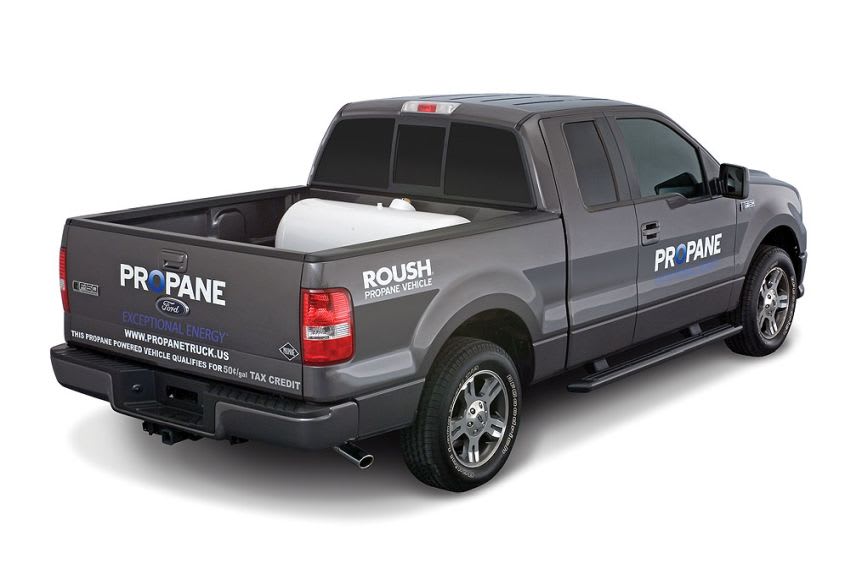
High fuel prices and environmental concerns continue to spark new alternative-fuel vehicle choices. The latest: dedicated propane-powered Roush F-150 LPI pickups, available this spring with delivery this fall.
Photo: Roush CleanTech
High fuel prices and environmental concerns continue to spark new alternative-fuel vehicle choices. The latest: dedicated propane-powered Roush F-150 LPI pickups, available this spring with delivery this fall.
The propane systems were developed by Roush Industries, based in Livonia, Mich., with costs partially subsidized by the Propane Education and Research Council (PERC), in Washington, D.C.
Roush is known for developing performance vehicles, such as the supercharged Roush F-150 and Mustang, and for assisting manufacturers in product development, such as front engineering and testing, and validating powertrains and chassis systems.
The trucks will be available on a ship-thru basis — sent from either Ford’s nearby Dearborn, Mich., assembly plant or its Kansas City plant to Roush’s processing facility, where their gasoline system will be stripped out and replaced with a liquid propane tank, brackets, lines, fuel pump, and fuel rail assembly injectors.
The vehicles will carry Roush’s logo to help identify them post-conversion.
Fleets Surveyed for Feedback
Roush, through its marketing and communications agency, ASG Renaissance, initially surveyed fleets nationally to determine their vehicle requirements.
As a result, the dedicated-fuel systems (designed to run only on propane) are expected to be available on F-150 Regular, Super Cab, and Crew models in 2WD or 4WD with Ford’s larger 5.4L V-8. The systems will provide:
The same 300 horsepower /365 lb.-ft. torque rating as the conventional 5.4L gasoline engine.
A 250 to 300-mile driving range between fillups.
An open bed, with propane tanks safely tucked beneath the vehicles.
Complete towing and recovery capability.
Roush plans to gauge demand early in the 2007 model-year to expand the propane systems to other models.
“The whole plan is to accommodate multiple engine families and multiple vehicles,” said Tom Arnold, Roush’s director of alternative fuels development.
The company is investigating the potential of F-250 and F-350 models equipped with the 5.4L and the E-Series with 6.8L V-10 as the next candidates for its propane system.
Along with private and governmental fleets and municipalities, Roush officials see the propane industry, with its many participants, as another potentially large market.
Determining the Economics
More than 800,000 propane-powered vehicles operate in the U.S., and some fleets report 2-3-year longer service life and extended maintenance intervals, according to the Alternative Fuels Data Center (AFCD), an online data collection site.
However, previous-generation models have experienced hard-starting issues in extremely hot or cold weather.
The CleanFUEL USA liquid propane injection system was the basis for the Roush engineering and design effort on the 5.4L in the F-150 and is sealed to prevent such issues, according to Arnold.
In cold weather, the injectors prevent hard-starting by injecting the liquid (rather than vapor, as with previous-generation propane systems) directly into the cylinders. They work just like gasoline injectors.
The closed system prevents hot-weather issues by purging vapors left in the fueling system or fuel rails. The fuel is always retained as a liquid; any vapors go back into the fuel tank, said Arnold.
From a service and maintenance standpoint, the liquid injectors are a direct fit with the gasoline engine injectors they replace. Diagnostic checks and servicing can be done using a dealership’s existing scanning equipment and tools.
“We learned a lot from the last Ford propane truck,” said Greg Zilberfarb, ASG commercialization and outreach manager for the propane F-150s. “We will make sure a dealership’s mechanics are trained, prior to delivery of a vehicle,” he added.
The trucks are expected to provide the same warranty coverage as their gasoline-engine counterparts.
Roush products are carried in about 330 Ford dealers. So far, the company has identified 150 U.S. candidates to sell the propane pickups, said Arnold. “There are certainly more to come. I’m still working out the arrangements, but we’ll have pretty good coverage for the fleet market,” he added.
Potential Costs and Benefits
About 85% of propane is produced domestically, and propane-powered vehicles can produce 60%t fewer CO and NOx emissions than gasoline engine vehicles, according to the AFCD.
While propane F-150s qualify for tax incentives and provide a clean/green “halo” effect, fleets ultimately must work cost benefits for themselves. Some key considerations:
Under the 2005 Energy Policy Act (EPAct), the trucks qualify for either a 50- or 80-percent tax credit, depending on their emission ratings, not yet determined, up to a maximum of $2,500 or $4,000, respectively. The tax credit helps defray the propane installation cost, expected to be about $5,500.
Fleets also get a 50-cent tax credit for every gallon of propane the trucks use.
With tax-exempt government fleets, the credit can be passed to fuel distributors, retailers, or producers, who can use it to reduce fuel prices to the fleet.
Propane costs, which have been fairly steady, ranging from $1.25 to $2 per gallon. They average about $1.65 in the Midwest.
However, propane vehicles (like ethanol) are about 20-percent less fuel-efficient, according to AFCD.
Propane is readily accessible. There are 2,499 propane fueling stations (versus 1,073 ethanol stations), according to AFCD.
More Green Fleet
Fuel Management's Next Evolution Centers on Connected Fleet Technology
Learn how fleets are integrating fueling, telematics, tank monitoring, EV charging, and data systems to improve efficiency and visibility.
Read More →
Landi Technologies Achieves CARB Certification of Ford 7.3L RNG/CNG Platform
Landi Technologies has gained CARB certification of its Ford 7.3L Renewable Natural Gas (RNG) and Compressed Natural Gas (CNG) platform for the Ford E-450, F-450/550/600, F-650/750, and F-53/59 platforms.
Read More →
Turning Connected Vehicle Data Into Decisions That Matter
Fleet leaders have more data than ever, but turning that data into clear, actionable decisions remains a challenge. This white paper shows how leading organizations are using connected vehicle data to improve safety, reduce costs, and optimize fleet performance. Learn how to turn insight into action across your fleet.
Read More →
Are You Tracking Your Fleet's True Total Cost of Ownership?
Bobit Business Media surveyed 190 fleet professionals and found that while most fleets are tracking costs, fragmented systems and data gaps are keeping true TCO visibility out of reach. With rising pressure to control spend in an increasingly volatile environment, the gap between what fleets think they know and what the data actually shows is wider than you might expect. See how your peers are managing costs today and where the industry still has room to improve.
Read More →
Epic Charging Acquires Bluedot Technologies
Epic Charging has acquired Bluedot Technologies, expanding EV fleet charging access to more than 80% of U.S. public charging networks.
Read More →
CALSTART Adds 64 New Sites and Features to Its Medium- and Heavy-Duty Zero-Emission Infrastructure Map
CALSTART’s interactive National Medium- and Heavy-Duty Zero-Emission Infrastructure Map now locates approximately 1,500 ports at 162 total public, semi-public, and shared electric vehicle (EV) charging and hydrogen refueling facilities for Class 2b-8 trucks.
Read More →
Mack Trucks Expands Full-Service EV Infrastructure Providers
Mack Trucks has expanded its comprehensive Turnkey Solutions program for Mack battery-electric vehicle customers with the addition of two new full-service providers, ABM and Lane Valente Industries.
Read More →
EV Realty Opens Major Truck Charging Hub in California’s Inland Empire
EV Realty’s San Bernardino Powered Properties’ truck charging hub, which has now opened, can serve over 200 medium- and heavy-duty trucks per day.
Read More →
WEX Launches Solution to Close the EV At-Home Charging Visibility Gap for Fleets
WEX unveiled its EV At-Home with Vehicle Fraud Protection, which ensures accurate and secure reimbursement for at-home charging.
Read More →
Toyota Motor Corporation to Join Daimler Truck & Volvo Group in Fuel Cell Joint Venture Cellcentric
Toyota intends to join Daimler Truck and Volvo Group as an equal shareholder in Cellcentric. All three shareholders intend to further strengthen Cellcentric as a leading manufacturer of fuel cell systems for heavy-duty commercial applications.
Read More →